Three Tu-95MS bombers airborne from Olenya: what the pattern says about Russia's deep-strike tempo
A coordinated alert from three Ukrainian open-source channels on 5 July 2026 puts three Tu-95MS strategic bombers in the air from the Kola Peninsula. The tempo of these launches has become the single best leading indicator of the nightly missile campaign.
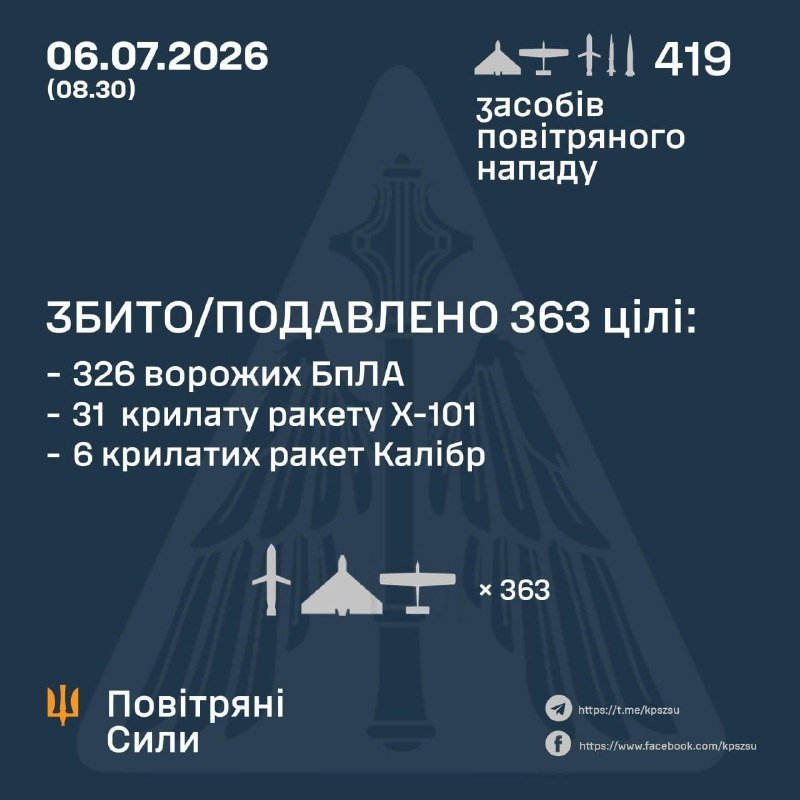
At 20:54 UTC on 5 July 2026, monitors flagged three Tupolev Tu-95MS strategic bombers lifting off from Olenya airfield on the Kola Peninsula in Russia's far north. Within five minutes two further open-source intelligence feeds — Ukrainska Pravda's UNIAN network and the Ukrainian Air Force-affiliated operativnoZSU channel — corroborated the report, and war correspondent Andriy Tsaplienko's feed added a third independent confirmation by 20:59 UTC. The convergence of three separate monitoring channels inside a five-minute window is itself the story: in the third summer of the full-scale invasion, the airborne pattern of Russia's strategic-bomber force has become one of the most reliable leading indicators of the nightly missile and drone campaign against Ukrainian cities.
The Tu-95MS — NATO reporting name "Bear" — is a Cold War-era turboprop designed in the 1950s to carry cruise missiles against targets in North America. Three decades past its intended service life, the airframe now serves as the launch platform for Kh-55 and Kh-101 cruise missiles fired at Ukrainian energy infrastructure, military depots and, periodically, civilian rail hubs. Olenya, in Murmansk Oblast, sits roughly 1,800 kilometres from Kyiv by air and is the closest of the three main Russian strategic-bomber bases — alongside Engels in Saratov Oblast and Ukrainka in Amur Oblast — to the Ukrainian border. Launches from Olenya typically give missiles a shorter time over hostile air defence and arrive in central and northern Ukraine faster than trajectories originating from the Volga or the Far East.
What makes tonight's alert analytically significant is not any single sortie but the rate at which these launches have been occurring in recent weeks. Ukrainian air-force and open-source monitors have, across the spring and early summer of 2026, logged an unusual density of strategic-bomber rotations from Olenya, often paired with Tu-160 "Blackjack" departures from Engels. The pattern — three Bears airborne simultaneously, with strike packages usually totalling between eight and twelve aircraft across both bases on a heavy night — has become the conventional opening move of a long-range strike wave. Ukrainian defenders read the absence of bombers in the air as the most reliable absence of cruise missiles; their presence, by the same logic, is treated as a near-term threat to grid and rail nodes.
Counter-narratives to this read do exist, and they deserve airtime. Some Russian-aligned channels frame these flights as routine strategic-aviation training unrelated to the war in Ukraine, citing the airframes' nominal nuclear-deterrence mission. The structural argument for that read is thin: in practice, Olenya's bombers have spent more time launching cruise missiles at Ukrainian transformer substations than simulating nuclear strikes for several years, and the telemetry — radio exchanges, transponder data and satellite imagery of pre-flight fuelling — published by Ukrainian open-source monitors consistently ties each wave to a missile salvo rather than a training sortie. The training frame is best understood not as a competing account of what the planes are doing tonight but as the standard denial layer.
In plainer terms: this is what a long-range war looks like inside the strategic-aviation cycle. A country with a shrinking inventory of long-range precision munitions is rationing them; the cue to launch is partly operational (a target set approved by the General Staff) and partly logistical (whether tanker aircraft, ground crews and missile-load crews can sustain another wave). Air-defence planners downstream of the cue have roughly two to four hours from wheels-up to impact, depending on the base of origin, to move Patriot and SAMP/T batteries, switch civilian grid loads, and shelter critical personnel. The bombers are the visible tip; the actual decision has already been made hours earlier by planners sitting in offices in Moscow and Rostov.
For the reader outside the air-defence community, the practical takeaway is sharper than the alert itself. Each Tu-95MS carries between six and eight cruise missiles externally and internally, depending on variant and loadout. A three-ship launch therefore puts a credible salvo of eighteen to twenty-four cruise missiles into the air within hours — a salvo designed to overwhelm rather than to evade, since the aircraft themselves rarely enter Ukrainian airspace and launch from stand-off range. Ukraine's layered air defence, supplied and sustained principally by Western partners, has performed credibly against these waves since 2024 but faces a structural problem: intercepting a cruise missile costs an interceptor that costs an order of magnitude more than the incoming round. The economics of the campaign — not the geography — is what makes every bomber rotation material.
The information environment around these alerts is also worth noting. The three channels that confirmed tonight's launch — Tsaplienko, operativnoZSU and UNIAN — are Ukrainian open-source feeds with different editorial lineages: a frontline correspondent, an air-force-adjacent channel, and a major wire respectively. Their agreement within minutes is the closest the public gets to independent verification in real time, since the Russian Ministry of Defence publishes no operational information about strategic-aviation activity and Western reconnaissance satellites are not declassified in the relevant window. The asymmetry is itself the story: the public learns about a Russian strategic operation first through Ukrainian sources, and the Russian state confirms nothing.
What remains uncertain is whether tonight's salvo will produce confirmed impacts, on which targets, and at what scale. The monitors flagging takeoff are not equipped to predict target packages; that decision sits inside Russian operational planning and only becomes legible hours later through the Ukrainian Air Force's morning summary and local reporting from impacted oblasts. Readers should treat any specific casualty or infrastructure figure attributed to tonight's wave with caution until cross-referenced against tomorrow's official briefings from the Ukrainian Air Force and the Ministry of Energy. The single fact the sources agree on is the launch itself — and that fact, on its own, is sufficient to reset the defensive posture across several Ukrainian oblasts before midnight.
This piece treats open-source monitoring channels as primary reporting on Russian strategic-aviation activity, in line with Monexus's sourcing approach to the air war. Where Russian state-aligned outlets would characterise tonight's launch as routine training, the dominant evidence base — telemetry, transponder data, and the post-event correlation with missile impacts — supports the operational-strike read.
Wire provenance
This editorial synthesis draws on the following public wire/social posts:
- https://t.me/Tsaplienko/
- https://t.me/operativnoZSU/
- https://t.me/uniannet/
- https://en.wikipedia.org/wiki/Tupolev_Tu-95
- https://en.wikipedia.org/wiki/Olenya_air_base
- https://en.wikipedia.org/wiki/Kh-55