Tehran fills the streets for Khamenei funeral as regional delegations converge
Millions gathered in central Tehran on Saturday for the funeral of Ayatollah Ali Khamenei, with delegations from Hezbollah and across the region arriving as Iran enters an unaccustomed transition moment.
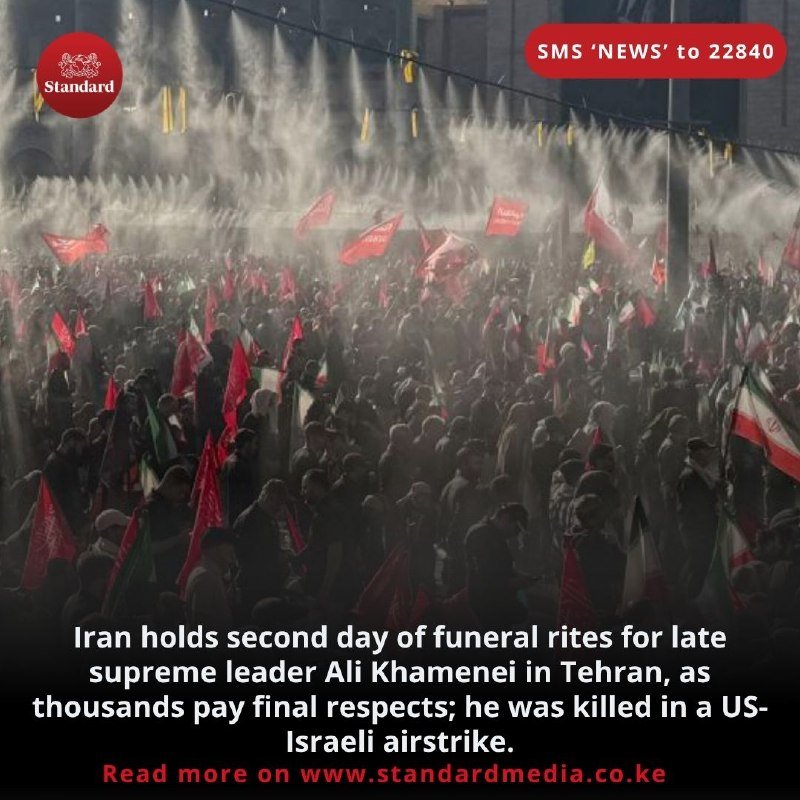
Central Tehran filled with what Iranian state media and Al Jazeera's coverage described as millions of mourners on Saturday, 5 July 2026, as the funeral prayer was held for Ayatollah Seyyed Ali Khamenei, the Leader of the Islamic Revolution, whose death IRNA and Tasnim had confirmed earlier in the week. Aerial footage released for the first time by IRNA showed the procession of the martyr leader's funeral prayer in central Tehran, with the capital's streets and squares packed beyond the ordinary capacity of major state commemorations.
The scale matters less as a demographic claim than as a political signal: the Islamic Republic is now navigating a transition, and the funeral is the first sustained public test of how the system performs without the man who held it together for more than three decades. Regional delegations have already begun arriving, with the choreography of those arrivals likely to shape how the transition reads in Beirut, Baghdad, Damascus and beyond.
A ceremony calibrated for the cameras
Both IRNA and Tasnim framed Saturday's coverage through Al Jazeera's reporting. According to IRNA, citing the Qatari-based network, millions of people attended the funeral of the martyred leader in Tehran, with Al Jazeera providing extensive live coverage of the funeral ceremony. Tasnim carried the same Al Jazeera line in its 07:10 UTC bulletin. Iranian state outlets amplify foreign coverage of crowd size when it suits them — that is standard practice — but the choice to lean on Al Jazeera rather than a domestic tally is itself telling, given the frostier tone between Tehran and Gulf-based media in other contexts.
The aerial footage, released for the first time by IRNA at 08:08 UTC, is the kind of image that travels: a city beneath the camera, a single funeral prayer binding it. Iranian outlets have used such imagery for years to project unity and reach. What is new is the context. Khamenei led Iran through the end of the Iran-Iraq war, through the nuclear file, through Soleimani's killing, through October 2023 and its aftermath, and through two decades of sanctions architecture. Saturday is the first national ritual of the post-Khamenei era.
Hezbollah in the front row
The regional choreography is already visible. At 06:14 UTC on Saturday, IRNA reported that an official delegation from the Lebanese Hezbollah, led by Muhammad Fneish, met with Foreign Minister Araghchi in Tehran during a visit to attend the ceremony honoring the martyred Leader. Fneish is a senior Hezbollah figure who has served in successive Lebanese governments and was sanctioned by the United States in 2020 over his role in the group's political and financial operations.
His presence in Tehran, and the public meeting with the foreign minister, signals two things at once. First, that the Tehran–Beirut axis intends to present itself as continuous rather than ruptured by Khamenei's death; second, that Iran intends to use the funeral as a stage for the regional network it built under his watch. Hezbollah is the most visible foreign delegation named in the morning's coverage. The pattern is likely to widen through the day.
What the funeral is for
State funerals in the Islamic Republic do double work. They are moments of public grief, certainly, but they are also the moments when the system's internal hierarchy — clerical, military, political — is photographed together. Cameras record who stands where, who is shown in frame with whom, and which officials read which prayers. That visual record will be read in capitals from Riyadh to Washington, and read again inside Iran by factions positioning for what comes next.
Iranian state media's choice to elevate Al Jazeera's reporting over its own correspondents on Saturday, and to release the aerial footage at the moment foreign delegations were already in town, points to an audience calculation. The image Iran wants to project is of an orderly, deeply mourned transition with regional allies visibly present — not of a contested succession in a weakened state. That image will not be settled by Saturday's ceremonies, but the cameras will set the terms on which the next phase is argued.
Stakes and what remains uncertain
The structural question the funeral cannot answer is the one Tehran's rivals are watching most closely: who consolidates authority inside Iran after Khamenei, and how that figure relates to the regional axis built around Hezbollah, the Iraqi militias, the Houthis and Tehran's intermittent coordination with Damascus. Muhammad Fneish's meeting with Araghchi suggests the foreign-policy posture is being held steady for now. Whether that posture outlasts the transition, or whether it adjusts as a new leadership calibrates to sanctions pressure, nuclear-file diplomacy and an unresolved regional security landscape, is the question the next weeks — not the next hours — will answer.
The sources do not specify casualty figures, the precise route of the procession, or the full list of foreign delegations present beyond Hezbollah. The headline from Saturday is the scale of the public gathering, the choreography of allied visits, and the system's capacity to perform continuity under the eyes of a region that has every reason to read it closely.
Desk note: Monexus reported Saturday's funeral from Iranian state-media wires (IRNA, Tasnim, Mehr) and the Al Jazeera coverage they amplified, rather than from wire agencies that had not yet published. Where crowd-size claims appear, they are attributed to those outlets; the structural reading — a transition photographed for an audience that includes Riyadh, Washington and Beirut — is this publication's own framing.
Wire provenance
This editorial synthesis draws on the following public wire/social posts:
- https://t.me/Irna_en
- https://t.me/mehrnews
- https://t.me/tasnimnews_en
- https://t.me/Irna_en
- https://en.wikipedia.org/wiki/Ali_Khamenei
- https://en.wikipedia.org/wiki/Muhammad_Fneish