CENTCOM strikes 80-plus Iranian targets as Hormuz toll threat to shipping intensifies
U.S. Central Command says it hit more than 80 targets in Iran and destroyed over 60 IRGC small boats after Tehran escalated attacks on commercial shipping in the Strait of Hormuz.
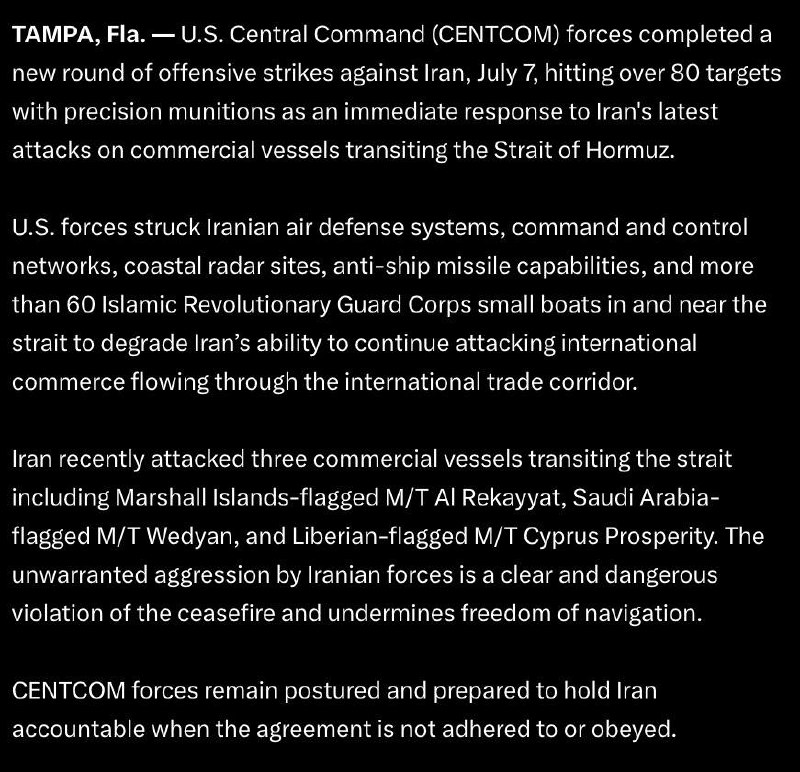
U.S. Central Command wrapped up a fresh round of strikes against Iran on Tuesday, 7 July 2026, hitting more than 80 targets with precision munitions and destroying over 60 Islamic Revolutionary Guard Corps small boats, according to CENTCOM statements carried on Telegram channels at 01:46–01:54 UTC on 8 July. The Tampa-headquartered command framed the operation as an immediate response to what it described as an intensification of Iranian attacks on commercial shipping in the Strait of Hormuz — an escalation first flagged by the Guardian earlier the same day and amplified by Iranian officials declaring a sovereign right to control "parts" of the waterway.
The episode folds a kinetic military exchange into a quieter contest over the most consequential energy corridor on earth. Roughly a fifth of the world's oil moves through Hormuz; any sustained disruption transmits through bunker prices, freight rates and risk premia within hours. The latest round is small in target count compared with a full aerial campaign, but the choice of targets — naval craft rather than fixed installations — signals a U.S. intent to keep the exchange at sea rather than allow it to metastasise into territory-strikes that would draw Tehran's regional partners into the fight.
The strikes, in detail
CENTCOM's own framing of the operation is the load-bearing claim in the current reporting. Telegram channels carrying the command's release — War Footage Witness at 01:46 UTC and 01:50 UTC, and the Russian-language R.N. Intel channel at 01:54 UTC — quote a CENTCOM statement issued from Tampa, Florida, that says U.S. forces "completed a new round of offensive strikes against Iran, July 7, hitting over 80 targets with precision munitions." The same statement says U.S. forces struck "more than 60 IRGC small boats" in the course of the operation.
The release ties the strikes explicitly to Iranian behaviour at sea, calling them an "immediate response to Iran's late[st]" attacks on commercial shipping in the strait. Independent corroboration of the target count and boat losses was not available inside the source set reviewed for this article; the figure of 80-plus targets and 60-plus boats currently rests on the CENTCOM statement itself and on the Telegram channels that have republished it. The operation appears to have been announced and concluded within a roughly 24-hour window from initial reports of escalation to the formal completion notice — short enough to suggest a planned, pre-packaged response rather than an improvised retaliation.
The Hormuz framing contest
Running alongside the strikes is a parallel contest over the legal and political framing of the strait itself. Two Polymarket-affiliated posts at 16:34 UTC and 16:59 UTC on 7 July report an Iranian declaration that Tehran has "a sovereign right to control 'parts' of the Strait of Hormuz," with one of the same platforms placing a 50 percent implied probability on Iran introducing transit fees on Hormuz shipping by the end of the following month.
That claim does not survive contact with established maritime law. The 1982 United Nations Convention on the Law of the Sea, to which Iran is a party, treats the strait as a route used for international navigation in which transit passage may not be impeded; coastal-state sovereignty does not extend to suspension of passage through it. Iran's standing counter-position has long been that the legal regime requires mutual recognition of bordering-state rights — including over security — and that unilateral Western naval presence is itself a violation. Both framings should be on the page; the legal text favours the Western position, but the political reality is that Iran's geography gives it leverage no convention can extinguish.
A related Polymarket market (poly.market/cPZbyAu) is treating Hormuz transit fees as a credible-tail event rather than a baseline assumption. The 50 percent price reflects genuine uncertainty about whether Iran would attempt a fee regime it cannot easily enforce against naval escorts, or whether the price tag is a signalling device aimed at a domestic audience and at negotiators in any future channel.
What the shipping picture looks like
The proximate trigger for the U.S. operation, as CENTCOM cites it, was an intensification of attacks on shipping in the strait. An Unusual Whales post at 16:27 UTC on 7 July flagged that the Guardian had reported Iran had "intensified attacks on ships in the Strait of Hormuz," and a follow-up post at 21:35 UTC from the same channel pushed reporting that CENTCOM had begun launching strikes.
The Guardian attribution matters: it places the escalation narrative on a wire that does not have a stake in either side's spin. The shipping dimension also explains the choice of targets. Small-boat strikes — fast attack craft, drone launches, limpet-mine teams — are the cheap and deniable instruments Iran has favoured since the seizure of the Stena Impero in 2019 and the attacks on the Mercer Street and the Pacific Zircon in 2021. Burning them out at the dock or at anchor in Iranian ports is a counter-instrument designed for that specific threat.
The structural frame here is the long-running tension between Iranian asymmetric capability in the strait and the U.S. Navy's surface and air supremacy in the wider Gulf. Neither side has an interest in letting that asymmetry collapse into a full conventional engagement; both have an interest in demonstrating capability. The 80-target, 60-boat figure lands in the space between signalling and escalation.
Stakes and what remains uncertain
If the trajectory continues, three groups absorb the immediate costs: commercial shippers, who absorb higher war-risk premia and longer voyages; Gulf states, whose export revenues move through the same corridor; and Iranian civilians, who will see their country under periodic kinetic pressure without an off-ramp that does not also carry domestic political cost. Energy importers in Asia and Europe are downstream of all three.
The dominant framing — a calibrated U.S. response to Iranian maritime aggression — holds up against the source set, but only just. Several pieces are still soft: independent confirmation of the target and boat counts, the identity of the specific Iranian facilities struck, the operational status of the Strait itself, and any statement from Tehran beyond the sovereignty claim that Polymarket flagged. The Polymarket probability on Hormuz fees is, by construction, the market's read; it should not be reported as a forecast. And the Iranian legal position, even where it does not prevail under UNCLOS, carries enough political weight in regional diplomacy that it cannot be dismissed as cover for escalation.
The next test is whether the exchange reverts to the pattern of the last several years — strikes, de-escalation, a quiet channel, and a return to attritional harassment of shipping — or whether the 80-target count marks the start of a more sustained campaign. Tuesday's CENTCOM statement is built for either reading.
Desk note: Wire coverage led with the Guardian's shipping-attack reporting and with CENTCOM's own statement. Monexus centred the legal framing of the strait and the small-boat counter-force logic, both of which the wire ledes elided in favour of a strikes-and-targets frame.
Wire provenance
This editorial synthesis draws on the following public wire/social posts:
- https://t.me/wfwitness
- https://t.me/GeoPWatch
- https://t.me/rnintel