Tehran's third wave: what the IRGC footage actually shows
Iranian state media has released launch footage of Khaybar Shekan and Zulfiqar ballistic missiles struck at US bases in a third IRGC wave, with a sticker taunting Trump mounted on at least one airframe.
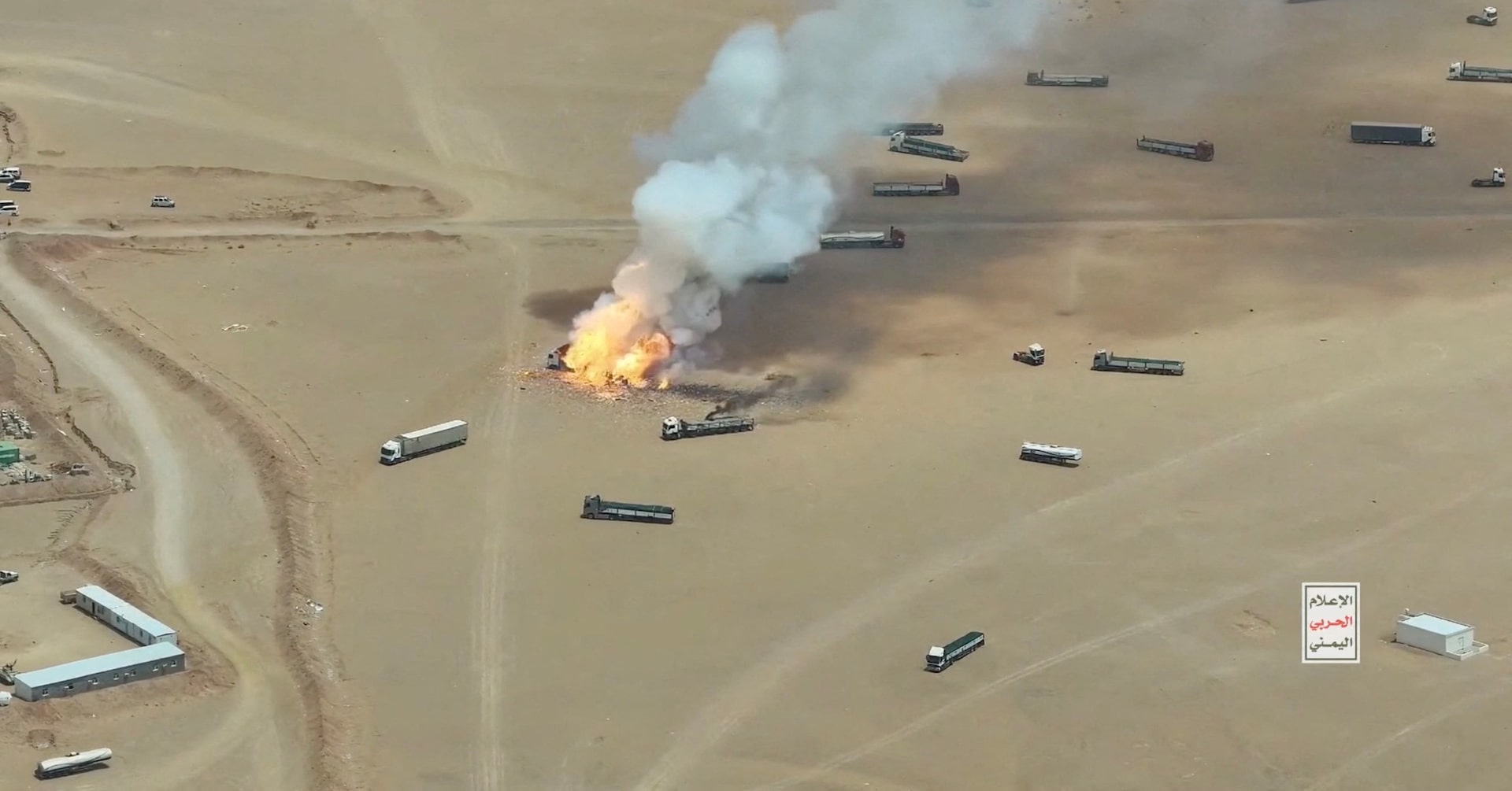
Footage aired on 14 July 2026 by Iranian state television shows the preparation and launch of two solid-fuel ballistic missiles, the Khaybar Shekan and the Zulfiqar, that Iranian officials say were used in retaliatory strikes against US bases. The video, summarised by Press TV's Telegram channel at 19:55 UTC, places both systems on transporter-erector-launchers in what appears to be a desert posture, with crews running through pre-launch checks before the cameras cut to a salvo of exhaust plumes lifting off-frame. The clip runs in a loop alongside captions identifying the systems and the operation as part of Iran's response to earlier US strikes.
The release matters less for what it confirms about damage than for what it confirms about the operation's choreography. Iran is no longer letting the kinetic phase of the retaliation speak entirely for itself. It is producing imagery, naming the systems in plain text, and seeding that imagery into both state media and open-source intelligence feeds almost in real time. The third wave, identified by the OSINT channel Open Source Intel at 20:30 UTC as the launch of a third wave of IRGC Operation "Nasr 2" firing both "Kasir Khaybar" and "Zulfiqar" drones and missiles, is the first time in the current exchange that Iran has publicly matched its missile and drone inventories inside the same wave. The earlier rounds leaned more heavily on one-shot drones; this one is mixed, and the mixed payload is the message.
What the footage actually shows
The Press TV cut is short on operational detail by Western analytical standards and long on display. There is no footage of the missiles in flight to impact, no terminal phase, no battle-damage assessment. The IRGC, for the moment, is offering the public the preparation sequence: fuelling, erector raise, ignition, the characteristic first-stage bloom of a solid-fuel motor. Both the Khaybar Shekan, a two-stage solid-fuel medium-range ballistic missile with a reported 1,450-kilometre range, and the Zulfiqar, a longer-range three-stage derivative, are framed in the Iranian defence press as precision strike systems optimised for fixed infrastructure. The footage does not, on its own, settle how many rounds were fired, from which garrisons, against which targets. Those specifics remain in the casualty and damage reporting carried by Western and regional wires, not in the launch clips themselves.
What the footage does settle is the chain of custody. The systems are real, the crews are uniformed IRGC personnel, and the operation is being claimed on the record by the institution that ordered it. That is a different posture from plausible deniability, and it carries signalling weight: Iran is asserting authorship of every launch tube in the clip and inviting the world to count them.
The sticker, and what it does
At 20:30 UTC, the same Open Source Intel feed circulated a second image from the IRGC footage: a close-up of an IRGC missile bearing a sticker addressed to President Trump. The text, as transcribed by the channel, reads: "If they claim to have destroyed all or most of Iran's military capability, yet they are still being slapped..." The sentence is cropped at the edge of the frame; the rest of the message is not visible in the still. The taunt is plainly calibrated for an American news cycle that has been dominated by claims, repeated at senior levels of the US administration in recent days, that the Iranian military machine has been functionally broken.
The sticker is a small prop, but the choice to mount it is significant. A missile is a weapon. A sticker on a missile is a press release. By attaching a direct rebuttal of Washington's damage claims to the airframe itself, the IRGC fuses the two messages: the strike is the argument, and the argument travels at hypersonic speed. The signal audience is not Tehran, where the claims are dismissed by default; the signal audience is Washington, where the policy debate over whether the campaign has degraded Iran's deterrent is still live.
A third wave in mixed payload
Open-source reporting describes the latest salvo as a third wave of Operation Nasr 2, with both one-way attack drones, the Kasir Khaybar family, and the heavier ballistic missiles launched in coordination. Iran has used the "Nasr" branding before, most prominently during the April 2024 exchange with Israel, when Operation True Promise paired salvos of older Shahed-series drones with newer ballistic systems in a deliberate ladder of escalation. The current sequencing follows a similar logic, but compressed. The first wave appeared designed to draw out air defence; the second to saturate it; the third, by mixing drones and ballistic missiles in the same package, to test whether integrated US and regional air defence can handle the two threat classes simultaneously without burning interceptor stockpiles faster than they can be replenished.
This is the structural read the footage does not state but plainly supports: Iran is probing, not punishing. Each wave is a question addressed to a specific layer of regional air defence, and the answers are visible in the public engagement timelines carried by US Central Command and partner air forces. The Press TV and Open Source Intel releases are the public half of that conversation; the other half, the intercept counts and the radar tracks, is being disclosed, more sparingly, by the defending side.
The information contest, not just the military one
The release of uncut launch footage within hours of the strikes, the cross-posting by independent OSINT channels, and the deliberate taunt at Washington all point to an information contest that is now running on roughly the same clock as the military one. Iranian state media is competing for the frame, and it is using open-source distribution, including Telegram channels that aggregate into English-language OSINT feeds, to bypass the editorial gatekeeping of Western broadcasters. Western readers who encounter the footage this week are more likely to see it via a Telegram screenshot than via a Reuters or AP wire. That distribution path is itself a fact about the war: the Iranian account of the strikes is now travelling on the same platforms as the American one, and at comparable speed.
That does not make the footage accurate in the operational sense. Launch clips do not establish where a missile landed, what it hit, or whether it was intercepted. The Western wire reporting on actual damage, including the location and condition of the bases, remains the load-bearing record. What the Iranian footage does establish is capability, intent, and the willingness to assert both on camera. After two weeks of public claims from Washington that Iran's military has been reduced to a shadow of itself, that assertion carries non-trivial political weight, both inside Iran and in the Gulf states whose airspace the missiles have transited.
What remains uncertain
The footage does not resolve the most consequential open questions. It does not disclose the number of missiles fired in this wave, the bases targeted, or the casualty and damage outcomes on either side. It does not confirm whether the US air defence umbrella absorbed all the inbound rounds or whether any landed, and where. The independent OSINT community has, to this point, validated the launch imagery but not the engagement outcomes. Until independent imagery emerges from the targeted bases, or until the US and Iranian governments publish damage assessments, the balance of the war's record will be carried by competing claims rather than by corroboration. The stickers, the salvos, and the state-media edits are part of the story; they are not the whole of it.
This article draws on Iranian state media and open-source intelligence feeds released in real time on 14 July 2026. Where independent Western or regional wire confirmation of strike outcomes is not yet available, Monexus has flagged the gap rather than infer it. The launch footage establishes Iranian authorship of the third wave of Operation Nasr 2; the damage ledger remains open.
Wire provenance
This editorial synthesis draws on the following public wire/social posts:
- https://t.me/presstv/
- https://twitter.com/Osint613/status/2077124345579622485
- https://t.me/osintlive/
Follow the event.
These dated source records provide context. They do not retrospectively verify this archive article.
Separate what the nuclear watchdog reported from what it could not determine after the June 2025 strikes.