Fifty percent and counting: how Trump's latest tariff salvo resets the US-Canada trade corridor
On 20 July 2026 the White House signed a fresh 50% tariff order on Canadian goods. The dollar mechanics, the carve-outs, and what Ottawa can actually do about it.
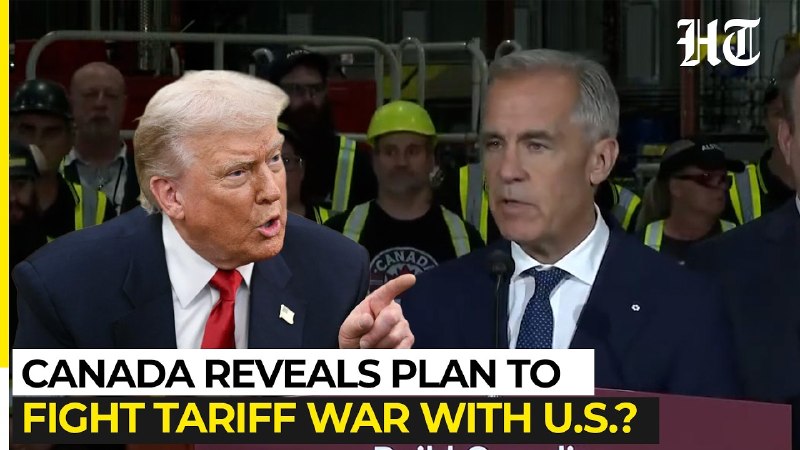
At 21:46 UTC on 20 July 2026, with the European afternoon still young, US President Donald Trump signed an executive order imposing a 50% tariff on a defined basket of Canadian goods. The White House framed the move as a response to what it called Canada's "discriminatory treatment" of US alcohol, automobiles and dairy, according to reporting from Reuters cited by France 24 and Deutsche Welle. The order was telegraphed through the morning, then confirmed by the President's signature. By 22:34 UTC, the line was already being reshared across financial Telegram channels. The clock on the US-Canada trade corridor had just been reset, and the rest of North American industry was about to feel the tick.
The new tariffs sit on top of, not in place of, a tariff architecture that has been ratcheting upward since the start of 2025. The list is narrower than a blanket border tax, but the rate is punitive. Energy and fish are excluded, as Deutsche Welle noted in its initial wire copy, but products including wine and hockey sticks fall inside the new 50% band. The list reads like a tariff aimed at political theatre and at specific provincial constituencies rather than at the bilateral goods balance as a whole. Canada's energy exports remain largely untouched, which means the action targets finished consumer goods, agri-food products, and the manufacturing inputs that cross the border multiple times before becoming a finished vehicle.
The mechanics of a 50% line
A 50% tariff is, by design, a market-closing rate. At 25%, importers can absorb the cost through margin compression, modest price increases, or a shift in supplier. At 50%, the arithmetic stops working for almost any non-essential good. The classic economist's tariff schedule treats 50% as the threshold above which volume collapses toward zero rather than tapering gradually. The intent, on the US side, is not to raise revenue; the United States already runs a goods deficit with Canada that means most of the new duties will not, in fact, flow back to Washington in significant quantities. The intent is to make the named Canadian product politically untenable inside US retail.
The carve-outs tell their own story. Energy is left alone because refiners in the US Midwest are configured for heavy Canadian crude, and a 50% tariff on Canadian oil would simply redirect flows to Chinese and Indian buyers at a discount the US refining complex cannot offset. Fish is left alone because processors in Atlantic Canada supply lobster and scallop inventories that US restaurant chains have no ready substitute for, and because the US Northeast's own fishing fleets depend on the same processing facilities. The tariff is, in other words, surgically drawn: it hurts Canadian factories and Canadian farms where the United States can plausibly substitute supply from somewhere else, and it spares Canadian resources where it cannot.
This is the part of the picture that wire-level coverage tends to flatten. "Trump imposes 50% tariffs" is true, but it is not the whole story. The list, the carve-outs, and the choice of products together constitute a political document. Wine is in; whisky and bourbon are out. Hockey sticks are in; aluminium and steel are already governed by separate Section 232-style measures and remain untouched. Lumber, the perennial irritant in the bilateral trade ledger, is not mentioned in the initial reporting, suggesting it will be governed under its existing framework rather than swept into this order. Each line of the schedule has a constituency behind it.
What Ottawa can plausibly do
The honest answer is: less than its first rhetorical response will suggest, and more than the White House order implies. Canada retains three serious levers, each with a different price tag.
The first lever is retaliation under the USMCA dispute-settlement mechanism, the successor agreement to NAFTA that governs continental trade. Retaliatory tariffs of comparable magnitude on US goods entering Canada would not, on their own, change the underlying balance: the Canadian market is roughly an order of magnitude smaller than the US market, and a dollar-for-dollar response punishes Canadian importers more than it punishes the White House. Where it bites is politically. Ontario auto parts plants, Quebec aluminium smelters, and Prairie agricultural exporters all have US-owned upstream and downstream counterparts; a Canadian counter-tariff would be felt in US congressional districts faster than the original measure would be felt in Canadian ones.
The second lever is regulatory. Canada has, in the past decade, used dairy quota management, digital services tax drafts, and provincial liquor board procurement rules as friction points against US exporters. The dairy framing is the load-bearing one here: the White House cited Canadian dairy treatment of US producers as a specific grievance, and Canada's retaliatory moves on US dairy access are the most politically resonant at the provincial level. Ontario and Quebec both have farm lobbies with direct lines into Ottawa.
The third lever is the one the wire is least likely to name: Canadian critical-mineral supply. Canada is the principal non-Chinese source of nickel, cobalt, potash, and uranium for the US defence and EV battery supply chains that this administration has, separately, declared strategically vital. A coordinated Canadian slowdown of permit approvals on US-bound critical-mineral shipments would not appear on a trade-balance table, but it would land in the earnings calls of US battery and defence primes within a quarter. Whether Ottawa has the political nerve to reach for this lever is the question that will define the next ninety days.
The structural read
Stripped of the daily noise, what is happening on 20 July 2026 is the continuation of a tariff architecture that has now been under construction for roughly eighteen months. The first round of broad-based tariffs, imposed in early 2025, was framed as a national-security measure under emergency authorities. The second round was a renegotiation of the USMCA framework with Mexico and Canada conducted in parallel. The third round, the present one, is bilateral and product-specific. Each round has narrowed the aperture and sharpened the targeting.
This is how trade-policy realignment actually works in a presidential system with statutory tariff authority: not as a single dramatic rupture, but as a sequence of measures, each defensible on its own narrow grounds, each ratcheting the cumulative cost upward. The political economy of the sequence matters more than the content of any single order. By the time a downstream importer or retailer is asked to absorb the third or fourth round, the cumulative burden has long since passed the point at which a single tariff line can be absorbed through price.
For Canada, the deeper structural problem is concentration. The Canadian economy is, in trade terms, a single-customer export economy at extraordinary scale: roughly three-quarters of Canadian goods exports go to the United States, a ratio without parallel among the OECD economies. There is no realistic diversification that closes that gap within a five-year horizon. Beijing has, periodically, been floated as the alternate market, and there is real growth in Canadian canola and lumber exports to China. But the underlying compositional mismatch (Canada exports what China does not need at scale, and needs what Canada does not produce in volume) means that diversification is a multi-decade project, not a tariff-cycle hedge.
The counter-narrative and what it misses
The dominant framing, in the immediate news cycle, treats the 50% tariff as retaliation for Canadian dairy and alcohol restrictions. That framing is the White House's own, and it is not false on the facts. Canada does operate a supply-managed dairy regime with restricted US access, and provincial liquor boards do favour some domestic categories. But the framing also flatters the US side by treating these measures as the cause of the tariff, rather than as the named pretext.
The alternative read is that the present move sits inside a wider re-negotiation of the post-1994 North American trade settlement, in which the United States has been steadily pushing to re-embed manufacturing, particularly automotive manufacturing, inside its own borders. Under this reading, the 50% tariff on Canadian goods is not principally about dairy at all. It is about signalling to automotive assemblers that the cost calculus of integrated North American supply chains is about to change. Canada hosts roughly two million vehicles' worth of annual light-vehicle assembly, almost all of it dependent on duty-free movement across the US border. A 50% tariff on the Canadian content of an integrated vehicle is, in effect, a 50% tariff on the Canadian leg of the North American automotive production map. The car will not move to the United States tomorrow. But the marginal decision on the next plant, the next retool, the next generation of electric-drive components, has already shifted.
What this read does not capture is the political risk to the Trump administration itself. Midterm-cycle tariff salvos have, historically, been punished at the polls when they raised consumer prices on visible items faster than they delivered visible factory announcements. The present list is short enough, and the carve-outs generous enough, that the immediate consumer-price hit is modest. Wine prices in US retail will rise, but wine is not a staple. Hockey-stick prices will rise, but hockey sticks are bought once a decade. The cumulative effect is, in the short term, manageable for US households. The medium-term effect on North American industrial geography is the part that compounds, and it is the part the wire coverage does not yet see.
Stakes and the watch-list
The next sixty days will tell us whether the order is a negotiating instrument or a destination. If the order is followed within weeks by a USMCA side-letter negotiation, the tariff will be retired in exchange for concessions on dairy quota and on the treatment of US-produced wine and distilled spirits in Canadian provincial markets. If no negotiation materialises, the tariff becomes the new baseline, and downstream pricing, contract renegotiation, and retail reformulation decisions will begin in earnest before the US autumn.
Three things are worth watching. First, the Canadian response at the provincial level: Ontario's auto sector and Quebec's aluminium sector will be the first to register the impact, and the speed with which provincial premiers ask Ottawa to retaliate is a leading indicator of the political temperature. Second, the Mexican reaction. Mexico is the third leg of the USMCA stool and has, to date, been the focus of US tariff pressure on automotive content rules. A simultaneous Canadian and Mexican tariff pressure would be a stress-test of the trade bloc's coherence; the absence of it would tell us this is a bilateral escalation. Third, the response from critical-mineral and battery supply-chain actors. If US-listed mining companies with Canadian operations begin pre-announcing permit delays or revised guidance, that is the signal that Ottawa has begun to reach for its quietest, sharpest lever.
What remains genuinely uncertain, on the source material available this evening, is the precise scope of the product schedule. The wire reporting from Deutsche Welle confirms wine and hockey sticks as covered items and confirms energy and fish as excluded. It does not yet specify whether finished automotive vehicles are inside the 50% band or remain governed by the parallel USMCA automotive rules-of-origin regime. Reuters, per the France 24 and Deutsche Welle wire copy, frames the order around "certain" Canadian goods, which strongly implies a list rather than a universal tariff, but the list itself has not been published in the sources available at the time of writing. The Canadian government's official response, beyond the initial statement the Prime Minister's Office is expected to issue tonight, is also not yet on the record. Until both are public, the political and market reaction is being priced off a partial schedule.
That partial-schedule uncertainty is itself the story. Trade policy that operates by executive order, with named products and named carve-outs, runs faster than verification. The US-Canada bilateral relationship has, since 1867, run on predictability. Predictability was, more than any tariff line, the actual commodity being traded this evening. The 50% rate is the headline. The loss of predictability is the lede.
Desk note: Monexus framed this as the continuation of a multi-round tariff sequence, not as a standalone rupture. The wire coverage led on White House pretext ("discriminatory treatment"); we led on the product-schedule carve-outs and on critical-mineral leverage as the structural under-read.
Wire provenance
This editorial synthesis draws on the following public wire/social posts:
- https://t.me/MegaGeopolitics
- https://x.com/disclosetv/status/1234567890
- https://en.wikipedia.org/wiki/United_States%E2%80%93Mexico%E2%80%93Canada_Agreement
- https://en.wikipedia.org/wiki/Canada%E2%80%93United_States_trade
- https://en.wikipedia.org/wiki/Trump_tariffs
- https://en.wikipedia.org/wiki/Supply_management_(Canada)
- https://t.me/MegaGeopolitics
- https://x.com/disclosetv/status/1234567890
- https://en.wikipedia.org/wiki/United_States%E2%80%93Mexico%E2%80%93Canada_Agreement
- https://en.wikipedia.org/wiki/Canada%E2%80%93United_States_trade
- https://en.wikipedia.org/wiki/Trump_tariffs
- https://en.wikipedia.org/wiki/Supply_management_(Canada