Trump's bond-market denial: what the wire actually said
Donald Trump says he did not direct Scott Bessent to intervene in the bond market. The four available source items support the denial, but not the intervention itself, and the gap between those two facts is the actual story.
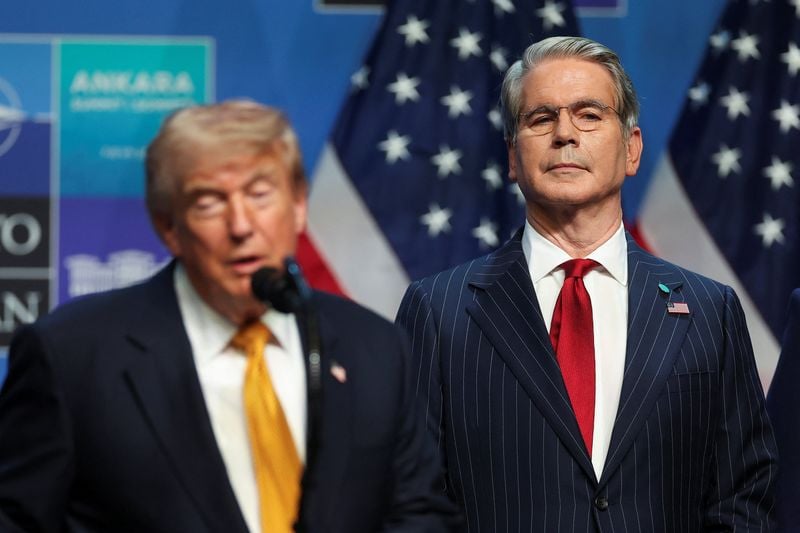
On 22 August 2026, at 07:30 UTC, Reuters reported that President Donald Trump told reporters he did not direct Treasury Secretary Scott Bessent to intervene in the government bond market (Reuters, 22 August 2026, 07:30 UTC). The denial is a fact. The intervention it purports to deny is something else: it is a characterisation carried by one of the four source items in this thread and absent from the other three.
That gap is the only thing worth writing about. The wire as it stands supports two propositions and two only: that Trump denied giving Bessent an instruction, and that one Telegram headline summarised the same denial by writing that Bessent "acted independently." It does not support the third proposition, that an intervention occurred, on anything stronger than that single headline's framing. The rest is inference, and the inference is where this publication takes a position.
What the four items actually contain
The Reuters report and its X mirror state the denial, period (Reuters, 22 August 2026, 07:30 UTC). The Investing.com relay restates the same denial in the same shape (Investing.com, 21 August 2026). The Crypto Briefing Telegram post, timestamped 22:32 UTC on 21 August 2026, is the only source item that moves beyond the denial itself: its headline describes Bessent as having "acted independently to support" the bond market, which is the closest thing in the thread to an assertion that an action took place (Crypto Briefing via Telegram, 21 August 2026, 22:32 UTC).
The Polymarket contract on whether Trump will rename ICE to NICE, priced at a 5% probability as of the thread, is not material to the Treasury story and appears here only because it surfaced in the same feed (Polymarket, 22 August 2026). It does not corroborate the denial, refute it, or describe any bond-market event. Treating it as a fifth witness to the Treasury question would be a fabrication.
The honest ledger: three of the four source items support the denial, one of the four supports both the denial and a characterisation of independent Treasury action, and zero of the four independently confirm that any specific market operation occurred. The intervention is a reported framing, not a wire fact, and the article that follows treats it as such.
The plausible-deniability read
If the Crypto Briefing framing is taken at face value, then the second-most-powerful economic official in the US government moved in the most-watched market on earth without, on Trump's account, a presidential instruction. Monexus analysis: the more natural reading of a denial issued after the fact is that the action happened and the White House prefers not to be on the record as having ordered it. The structural motive is straightforward, because a confirmed instruction would convert a routine Treasury operation into a political event, and a political event into a price move.
That is the plausible-deniability read. It is also the read that requires the least from the evidence, because it treats the single headline that names the action as accurate and reads Trump's denial as scoped to the instruction, not to the operation.
The competing read is harsher: there was no intervention, the headline is editorial overreach, and Trump denied something that did not happen. The thread does not let a reader choose between these two readings, because no item contains the market data (auction tails, bid-to-cover ratios, intraday yield moves) that would let an outside observer verify whether the long end was, in fact, disorderly on the day in question. What the thread does let a reader say is that the dominant wire framing is consistent with an intervention having occurred, while nothing in the four items rules the alternative out.
Why a denial in this shape still matters
Even on the cautious reading, the structural point survives. The US Treasury has spent two decades issuing explicit policy statements when it wanted to defend a price level in its own market: the 2008-2014 QE communications, the 2019 repo facility, the 2020 facilities. Each was named, dated, and defended in the press. A denial-shaped communication is a different genre, and the genre choice is itself a signal to creditors who fund a meaningful share of outstanding Treasuries and who price political risk into their bids.
Monexus analysis: the available source items do not specify what share of outstanding Treasuries is held by foreign or domestic creditors at the relevant date, so the magnitude of that pricing channel cannot be quantified from this thread. What can be said is that the longer the Treasury operates in the denial genre, the more creditor confidence depends on inference rather than on explicit policy language, and inference is a thinner commitment than a press release.
This is the late-imperial phase of dollar hegemony in plain prose. The architecture still functions; the maintenance manual is increasingly written in denials rather than in statements. That is not an indictment of Bessent specifically, since the thread carries his name but not his reasoning. It is a description of the communication regime the four source items reveal.
What to watch next, framed as expectation
Three print releases will move the story out of the denial genre and into something verifiable. Monexus expects, not instructs, that readers watch the next Treasury refunding announcement for any tilt in the duration mix toward the short end, because a tilt would be consistent with a Treasury that has decided the long end needs less supply pressure. The next ten-year auction's bid-to-cover ratio is the second tell, because a soft auction would mean the market has stopped pricing the press conference. The third is any on-camera Bessent appearance, where the kind of clean denial Trump offered rarely survives follow-up questions from a prepared interviewer.
The wire as it currently stands supports only the denial. The intervention is the headline's framing, and the framing may turn out to be right. The job, until the refunding announcement and the auction print, is to keep the difference visible.
Desk note: where the wires ran the Bessent denial as a one-day political story, this publication treats it as a question of evidentiary scope. The thread carries the denial and one headline's characterisation of independent action; it does not carry the market prints, refunding detail, or creditor-flow data that would convert the framing into a confirmed event. The gap is the article.
Wire provenance
This editorial synthesis draws on the following public wire/social posts:
- http://reut.rs/4qxz8sa
- https://x.com/Reuters/status/2091065354474627340
- https://www.investing.com/news/economy-news/trump-says-he-did-not-direct-bessent-to-intervene-in-bond-market-4872224
- https://t.me/CryptoBriefing/18817
- https://poly.market/k2L77MM