Trump Renames Lake Ontario as Lake America as Canada-US Trade Talks Collapse
BBC reported on 27 August 2026 that Donald Trump signed an order renaming Lake Ontario as Lake America after US-Canada trade talks collapsed. A separate X post attributed to Trump a suggestion that the Atlantic or Pacific oceans might also be renamed.
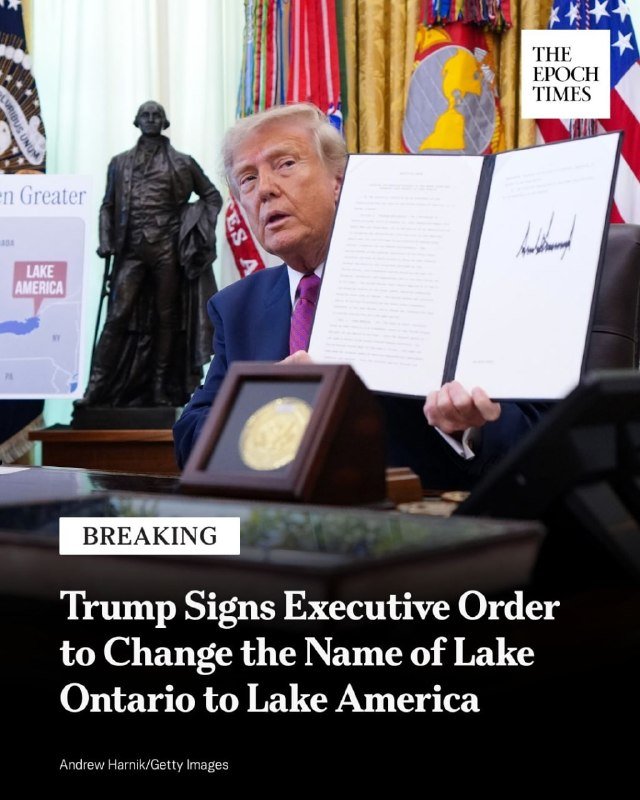
At 21:07 UTC on 27 August 2026, BBC News reported that Donald Trump had signed an order renaming Lake Ontario as "Lake America." The order came after trade talks between the United States and Canada collapsed late the previous week, according to the BBC. The move places a new American label on a lake shared by the two countries and makes the dispute about commerce inseparable, at least symbolically, from a question of geographic identity.
The order is the clearest fact in the available reporting. Its meaning is less settled. Trump has used tariffs and other economic measures to pursue bargaining leverage with Canada, while a unilateral renaming order operates in a different register: it changes language and political presentation without, on the evidence supplied here, changing the physical border or the practical arrangements that govern the lake. The contradiction is therefore not between a harmless symbol and a substantive act. It is between two different kinds of power. One changes the terms of trade. The other attempts to make a contested relationship appear to have a single national vocabulary.
The order and what it follows
The BBC's report identifies the action as an executive order signed by Trump. It also supplies the immediate political context: trade talks between the US and Canada had collapsed late the week before the 27 August report. That timing matters because the lake order arrived when the bilateral relationship was already under economic strain.
The source does not specify the order's operative text, its stated legal basis, or whether it changes official American nomenclature across all federal materials. It also does not specify whether Canadian authorities have been asked to use the new name. Those limits matter. An American order may establish a US usage without settling how the lake is described in Canada, and the available items do not establish that the order has a cross-border enforcement mechanism.
A separate X post from @SprinterPress, published at 21:02 UTC on 27 August 2026, said the US authorities had renamed Lake Ontario "Lake America." The post also reported that Trump had suggested renaming the Atlantic or Pacific Ocean. The item attributes the idea to Trump and presents it as a further suggestion, not as a completed action. Its wording about an ocean should therefore be treated as a reported proposal, not as a second executive order.
Canada rejects the premise
The strongest counterpoint is that the order is performative. A name can be changed in official American usage without changing water levels, commercial access, environmental management, or the border itself. On that reading, the order is a political message aimed at domestic audiences, not an attempt to transfer Canadian territory or alter the lake's physical geography.
That interpretation does not make the act inconsequential. Shared geography is part of the language through which political authority is expressed. By adopting a new name unilaterally, the US can change the frame through which its own institutions describe the lake. Canada can reject that frame and continue using Lake Ontario. The result would be parallel names, but not parallel control over the underlying relationship.
The available items do not state Canada's legal response, the language used by Canadian federal officials, or whether Ottawa issued a formal counter-order. They do establish that the order was made in the context of a trade breakdown, and that the X post attributed a further ocean-renaming suggestion to Trump. On the evidence available, the act looks more like a deliberate assertion of American political identity than a technical change to the management of the water.
A message written in names
The order should not be confused with a boundary change. The source material does not say that the international border moved, that Canadian jurisdiction over any part of the lake ended, or that either country's rights under existing arrangements were formally altered. The narrower claim is that the US has introduced a new official name for a shared lake.
That distinction cuts both ways. Sceptics are right that a label does not itself produce tariffs, border controls, or enforceable obligations. But a label can still become an instrument of bargaining when it is attached to a bilateral dispute. The more consequential interpretation is therefore not that "Lake America" alters the lake's physical geography. It is that the Trump administration has chosen to make a shared space part of the visual vocabulary of unilateral US pressure.
Monexus analysis: the order is best understood as a signalling device in a worsening economic relationship. Its domestic effect is to present US power as decisive and immediate. Its bilateral effect depends on whether Canada treats the label as a serious assertion of authority or as a provocation with little practical consequence. The former reading gains support from the order's placement after the collapse of trade talks; the latter remains plausible because the available sources do not describe any accompanying change to the lake's governance or physical control.
The unfinished threat of a larger map
The @SprinterPress item extends the symbolism beyond Lake Ontario. It says Trump suggested that the Atlantic or Pacific Ocean might also be renamed. If that account is accurate, the lake was not the outer limit of the idea. The suggestion is notable precisely because an ocean is not a US domestic object in the way a lake can be made to appear through a US order.
The same caveat applies. The source item reports the suggestion and does not say that an ocean-renaming order was signed. There is no evidence in the available thread of a second order, a legal instrument covering either ocean, or an official American map update. The proper conclusion is narrower: the lake order has generated a reported proposal for a still larger act of geographic rebranding.
That gap will be important to watch. If a future US directive attempts to rename either ocean, the issue would move beyond a bilateral dispute over a Great Lake. If no such order follows, the ocean reference will remain a revealing but unfulfilled rhetorical extension. The immediate test is not whether every symbolic statement becomes policy. It is whether the next US document turns the name on the map into a new working claim.
Stakes and the next signal
The central risk for Canada is not that a name alone will transfer authority. It is that economic disputes will increasingly be expressed through unilateral national gestures that Ottawa must answer politically. If the US continues to use tariffs, executive orders, and geographic rebranding as parts of the same bargaining strategy, Canada will have to distinguish between signals that alter the legal relationship and signals designed to test its willingness to resist.
For Trump, the order offers a domestically legible sign of action after trade talks failed. It can communicate resolve without requiring agreement from Canada. The cost is uncertainty: a symbolic challenge may harden Canadian resistance, close space for compromise, or encourage a parallel naming dispute. The sources supplied here do not specify Ottawa's response, so those outcomes remain possible rather than established.
The next consequential signal should be substantive. Watch for the text of the order, Canadian official reactions, and any joint or parallel instrument that addresses the lake's name or management. Until those records appear, the evidence supports one firm conclusion: on 27 August 2026, Trump signed an order renaming Lake Ontario as Lake America after US-Canada trade talks collapsed. What remains open is whether the label becomes merely another rhetorical boundary, or the opening of a more sustained contest over how the two countries describe their shared geography.
Desk note: Monexus treated the lake order as a political signal after the breakdown of trade talks, not as evidence of a physical or legal transfer of Canadian authority. The thread provides direct BBC reporting on the order and a separate X item on the reported ocean-renaming suggestion, but it does not provide the underlying order text or the original Axios material.
Wire provenance
This editorial synthesis draws on the following public wire/social posts:
- https://www.bbc.co.uk/news/articles/ckgwdn1g58yo?at_medium=RSS&at_campaign=rss
- https://x.com/SprinterPress/status/2093081802714050994
- https://t.me/noel_reports/51803
- https://t.me/osintlive/567456
- https://t.me/two_majors/82454