The daily barrage, and what the cameras miss
On 30 August 2026 the wires from southern Lebanon ran on a tight loop: town after town, strike after strike. The Strait of Hormuz also saw a tanker hit. The pattern is the story.
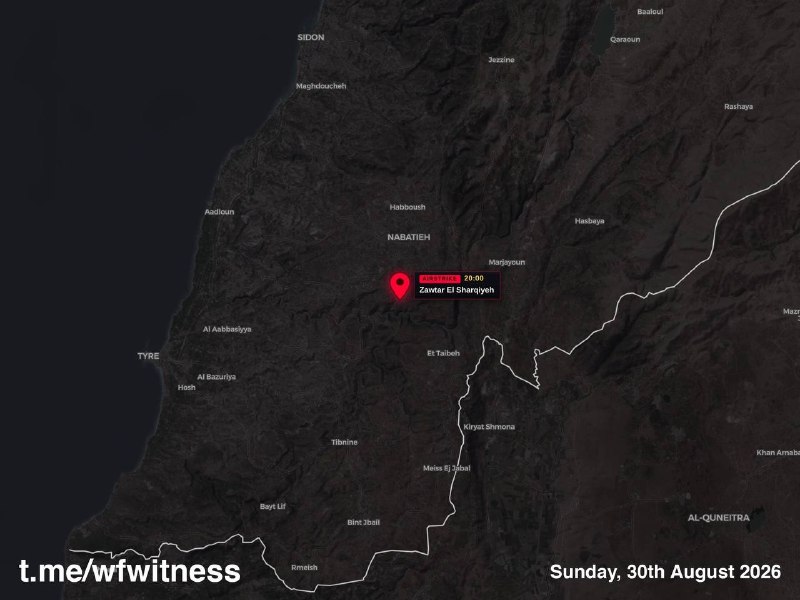
Within a span of roughly an hour on the afternoon of 30 August 2026, the Telegram channel wfwitness pushed out a sequence of dispatches from southern Lebanon: an airstrike on Al-Mansouri at 16:03 UTC, footage of the same strike at 16:05, jets over the south at 16:08, additional footage from between Maifadoun and Zawtar al-Sharqiyeh at 16:14, more jets at 16:15, and a confirmed strike on Zawtar al-Sharqiyeh itself at 17:02. Sandwiched in between, at 16:23 UTC, came a UKMTO notice that a tanker had been hit by an unknown projectile twelve nautical miles north of Khasab, Oman, while inbound through the Strait of Hormuz. Two theatres, one news cycle, both running hot.
The dominant frame, repeated hourly across Arabic- and Hebrew-language channels, is that this is the grinding continuation of an old war. The counter-frame, which deserves equal airtime, is that the framing itself is the asset being managed: a cadence of strikes so routine that the camera edits itself, and the international community files each event under "ongoing operations" rather than reading the cadence as the message. This publication's read is that the latter framing better explains the evidence on the wire.
The cadence, minute by minute
What is striking about the 30 August log is not any single strike but the absence of dead air between them. Wfwitness carried at least six posts on Israeli operations in southern Lebanon between 16:01 UTC and 17:02 UTC: artillery on Srbin and Al-Mansouri and an explosion in Yohmor al-Shaqif, attributed by Al-Manar to demolition activity; the airstrike on Al-Mansouri; jets overhead; the Maifadoun–Zawtar al-Sharqiyeh strike; jets again; and the confirmed hit on Zawtar al-Sharqiyeh. The geographic spread is narrow: a strip of villages north of the Litani, the kind of terrain that Israeli planners have been methodically working through for the better part of a year.
A counter-reading is that this is reactive fire aimed at specific Hezbollah infrastructure, not a campaign of area denial. The wfwitness dispatches do not specify what was targeted in each town; Al-Manar's reference to "demolition activity" is one of the few hints at tactical intent, and Al-Manar is a Hezbollah-aligned outlet, so the framing has to be weighted accordingly. Monexus assessment: the sheer density of the posts, six in an hour across a small cluster of villages, reads less like precision counter-fire and more like the steady industrialisation of a strike routine.
Hormuz, the second front
The UKMTO advisory on the tanker hit north of Khasab is a different kind of signal. UKMTO is the United Kingdom Maritime Trade Operations office in Dubai, the closest thing the merchant fleet has to a neutral incident-recorder, and it tends to understate. "Unknown projectile" is UKMTO shorthand for a weapon the ship could not identify; the location, twelve nautical miles off Omani territory in the strait's narrowest stretch, sits squarely inside the corridor where Iran has previously harassed or struck commercial traffic. No party has been named. The sources do not specify the tanker's flag, owner, or cargo, and this article has not independently established any of those details.
The counter-narrative here is the familiar one: that the merchant marine dramatises incidents for insurance and political leverage, and that a single projectile of unknown origin does not justify a regional crisis reading. That is fair, as far as it goes. But a tanker hit on the same afternoon that southern Lebanon is being battered is a coincidence the markets will price regardless of attribution. Monexus analysis: the Hormuz report should be read as an ambient-risk data point, not as a casus belli, and the prudent interpretation is that the strike tempo has now spilled out of the Lebanon theatre into the shipping lanes the global economy cannot insulate.
What the wire does not say
Here is where the editorial lens has to be honest. Every entry in the wfwitness log is a short, image-heavy Telegram post, several of them cut-and-pasted across the hour as additional footage arrives. The chain's bias toward visual content means it over-represents events that produce footage, which is to say kinetic events, which is to say strikes. Quiet days produce few posts; busy days produce many. The available source items do not specify casualty figures, infrastructure damage, displacement counts, or any official Israeli or Lebanese military readout for 30 August. Al-Manar appears as the named attribution for the artillery and demolition activity; no IDF spokesperson statement is reproduced in the thread. Monexus has not independently verified the casualty or damage toll, and the framing here is built from the cadence of the posts, not from a body count.
That caveat matters because the dominant frame on the Israeli side, carried by Hebrew-language outlets and IDF briefings on other days, is that these are targeted operations against re-established Hezbollah infrastructure. The dominant frame on the Lebanese side is that civilians are paying the price for a campaign that has run, in some form, since late 2023. Both frames have evidentiary purchase. Neither can be fully tested from a Telegram thread alone.
The stakes, stated plainly
If the strike tempo in southern Lebanon continues at the cadence logged on 30 August, three things follow. First, the slow-bleed displacement of villages north of the Litani continues, and the political argument inside Israel that this constitutes acceptable pressure on Hezbollah hardens. Second, the Hormuz tanker incident, whether Iranian, Houthi, or unattributable, raises the insurance and freight premium on every ship that transits the strait, and that premium is paid by importers from Mumbai to Rotterdam. Third, the international community's habit of treating each event as a discrete incident rather than a curve erodes further, and the diplomatic off-ramps narrow.
The lesson of 30 August is not that anything unprecedented happened. It is that the unprecedented would be a quiet afternoon, and that the absence of one is itself the political fact.
Wire provenance
This editorial synthesis draws on the following public wire/social posts:
- https://t.me/wfwitness/108840
- https://t.me/wfwitness/108839
- https://t.me/wfwitness/108838
- https://t.me/wfwitness/108837
- https://t.me/wfwitness/108835
- https://t.me/wfwitness/108832
- https://t.me/wfwitness/108831
- https://t.me/wfwitness/108829
- https://t.me/wfwitness/108827