Trump signals a short Iran campaign and floats renaming the Strait of Hormuz
On 2 September 2026, President Donald Trump said a renewed US campaign against Iran would not last long, claimed US strikes hit Iranian radar along the Strait of Hormuz, and said another attack could come at any time. Separately, an OANN headline reported that he had floated renaming the waterway.
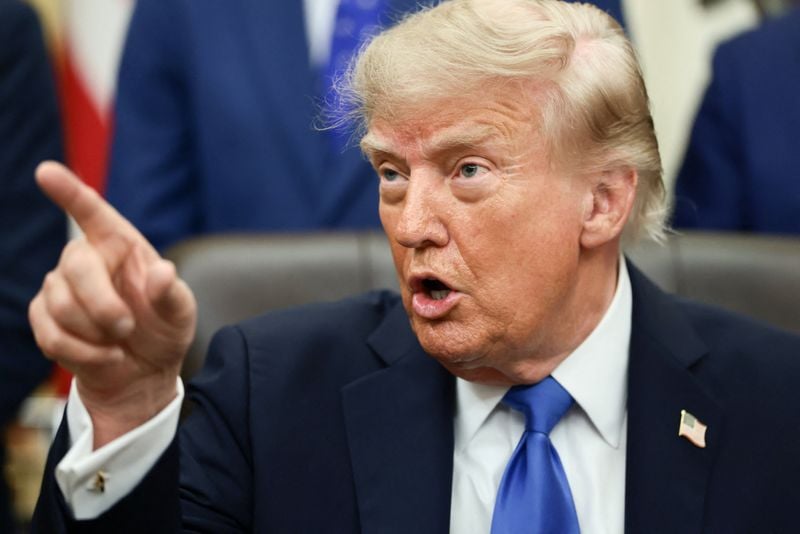
At 18:42 UTC on 2 September 2026, President Donald Trump told reporters that the renewed US campaign against Iran would not last long. The remark arrived amid claims that US forces had struck Iranian coastal and inland radar sites along the Strait of Hormuz and that Washington was prepared to strike Iran again at any time.
The contradiction is the point. Trump was presenting an operation that he described as heavy and repeatable while also insisting that it would be brief. The military message was escalation without an open-ended promise of war. The political message was narrower: Trump said he was not personally on the midterm ballot and argued that his party, rather than his own electoral prospects, was at stake.
The result is a campaign whose stated objective appears clearer than its exit conditions. The available source items describe attacks on radar and other equipment that Trump said Iran had placed along the waterway. They do not specify which sites were hit, what capability was lost, or whether further strikes have been ordered. Monexus analysis: the administration's public posture is best read as a claim of military leverage, not evidence that the underlying dispute has been resolved.
A short campaign with a long shadow
The most direct description came from Trump himself. A Telegram post from ClashReport at 18:48 UTC quoted him as saying: "It was a very heavy attack last night, and we are prepared to do another one anytime we want." InsiderPaper separately relayed the exchange at 18:50 UTC with the shorter formulation that Trump was prepared to strike Iran again at any time.
At 18:42 UTC, Investing.com reported that Trump said the renewed campaign would not last long. Middle East Eye also reported the remark later that day, while BRICS News relayed a related statement that Trump did not think the Iran war would last "much longer." These are not formal declarations of a timetable. They are public descriptions of how Trump expects the campaign to develop.
Monexus analysis: the significance lies in the pairing of claims, not in any one sentence taken alone. A president who says a campaign will not last long is not necessarily announcing withdrawal. In this case, the same sequence of remarks included a threat of another strike, making the apparent deadline conditional on the administration's own assessment of whether its objective has been achieved.
The energy relevance is direct because the remarks concern the Strait of Hormuz, a central maritime passage for oil shipments. But the source material supplied for this article does not provide a new price move, shipping disruption figure, or independent measure of traffic through the waterway. The defensible conclusion is narrower: the public discussion itself places the waterway at the centre of the claimed US operation.
Radar claims without an independent assessment
The most consequential operational assertion came in a post from OSINTdefender via the osintlive Telegram channel at 18:43 UTC. It quoted Trump as saying that Iran was having trouble identifying and seeing vessels in the Strait of Hormuz because of US targeting of coastal and somewhat inland radar sites.
A separate ClashReport post, timestamped 18:24 UTC, quoted Trump as saying: "We took out all of the new equipment that they tried to build along the Strait of Hormuz, some defensive, some offensive." The post also said Iran was trying to see ships but could not do so.
These statements identify the target category described by Trump. They do not independently establish damage, loss of coverage, or the effect on vessel movements. The available source items do not specify the location of the radar sites, the type of equipment, the number of targets, or the duration of any impairment. The cited posts are relays of the president's remarks, not independent battle-damage assessments.
That distinction matters. A claim that Iran is having trouble seeing vessels could be read as deterrence: the United States has demonstrated an ability to reach a component of Iran's surveillance and defensive infrastructure. It could also be read as escalation, because the stated aim is to reduce Tehran's ability to monitor shipping in a contested waterway. The source material supports the first claim as an attributed presidential assertion, but does not settle the broader strategic effect.
The energy consequences would depend on facts not established in the available items. They do not provide evidence of a closure of the Strait of Hormuz, a change in tanker routing, an insurance premium, a production disruption, or a new oil-price response. Any wider assessment should therefore begin with the military claim and avoid turning it into a market conclusion.
The waterway's new proposed name
At 18:16 UTC on 2 September, an OANN Telegram post carried the headline: "'TRUMP STRAIT': 47th President floats changing name of vital waterway." The item supports the narrow claim that Trump floated the idea of changing the name of the waterway. It does not establish that a renaming process has begun or that the United States has authority to make the change.
Polymarket listed a 9% probability that Trump would rename the strait. The market is an indication of assessed likelihood, not a forecast with independent authority. The available source item does not specify the market's resolution terms, and the quoted probability should not be treated as evidence that a policy change is imminent.
Monexus analysis: the renaming discussion is politically significant because it connects a military campaign to the president's personal political identity. That is an interpretation of the headline and the surrounding remarks, not a claim that the name change has operational effect. A geographic name can be proposed without changing navigation, legal jurisdiction, shipping practice, or the security balance in the waterway.
The proposal should also be kept separate from the military question. Whether Trump described the Strait of Hormuz as vulnerable to US strikes is distinct from whether he has a workable plan to rename it. The available evidence establishes only the reported discussion.
Election politics and the shape of escalation
At 19:04 UTC, an EnglishAbuali Telegram post quoted Trump discussing the possibility that the war with Iran could affect the US midterm elections. According to the post, he said: "The elections don't affect me. I'm not running. It's my party that's running." A separate ClashReport post at 18:50 UTC relayed the same distinction and said Trump believed his party respected that the United States was not allowing Iran to have a nuclear weapon.
The statements present Trump's own political posture. They do not establish how voters, members of Congress, or other governments will assess the campaign. They also do not provide a military timetable. The remarks are relevant because they show that the president was publicly linking the operation to a political defence of his party's control, while denying that his own candidacy was the immediate electoral mechanism.
Monexus analysis: the sequence suggests that the administration wants to keep the campaign bounded in duration without presenting it as a retreat. The same language can perform two political jobs. It can reassure domestic audiences that the operation is under control, and it can signal to Iran that the United States retains the option of another attack. Those purposes may be compatible from Washington's point of view, but they do not remove the risk of miscalculation.
The immediate test is not whether the rhetoric changes. It is whether the claims about radar and maritime awareness are followed by observable changes in the waterway. The available source items do not establish those changes. Until independent reporting supplies them, the safest reading is that Trump has described a new phase of pressure and possible escalation, while offering no precise endpoint.
This article framed the reported US campaign around its stated military objective, the uncertainty surrounding the radar claims, and the distinction between a proposed waterway renaming and an actual change in shipping or governance.
Wire provenance
This editorial synthesis draws on the following public wire/social posts:
- https://www.investing.com/news/commodities-news/trump-says-renewed-us-campaign-against-iran-wont-last-long-4886633
- https://www.middleeasteye.net/live-blog/live-blog-update/trump-says-renewed-us-campaign-against-iran-wont-last-too-long?topic=War%2520on%2520Iran&nid=442386&fid=557854
- https://t.me/insiderpaper/44319
- https://t.me/ClashReport/94790
- https://t.me/ClashReport/94781
- https://t.me/ClashReport/94791
- https://t.me/osintlive/569283
- https://t.me/osintlive/569279
- https://t.me/englishabuali/78675
- https://t.me/OANNTV/17237
- https://poly.market/aGS3TWk
- https://t.me/bricsnews/18068
- https://x.com/MiddleEastEye/status/2095231062943109255
- https://x.com/Polymarket/status/2095176758135865598
- https://www.investing.com/news/commodities-news/trump-says-renewed-us-campaign-against-iran-wont-last-long-4886633
- https://www.middleeasteye.net/live-blog/live-blog-update/trump-says-renewed-us-campaign-against-iran-wont-last-too-long?topic=War%2520on%2520Iran&nid=442386&fid=557854
- https://t.me/insiderpaper/44319
- https://t.me/ClashReport/94790
- https://t.me/ClashReport/94781
- https://t.me/ClashReport/94791
- https://t.me/osintlive/569283
- https://t.me/osintlive/569279
- https://t.me/englishabuali/78675
- https://t.me/OANNTV/17237
- https://poly.market/aGS3TWk
- https://t.me/bricsnews/18068
- https://x.com/MiddleEastEye/status/2095231062943109255
- https://x.com/Polymarket/status/2095176758135865598