Squawk 7500 over the Levant: the Flydubai diversion that landed in Tabuk
A Dubai-to-Tel Aviv flight briefly squawked the hijacking transponder code 7500 on 30 September 2026, dropped off tracking screens near Tabuk, and was met by Israeli Air Force jets. Monexus reads the limited source set, including a material Emirates-versus-Flydubai discrepancy in the Iranian-aligned coverage, on what the reporting does and does not establish.
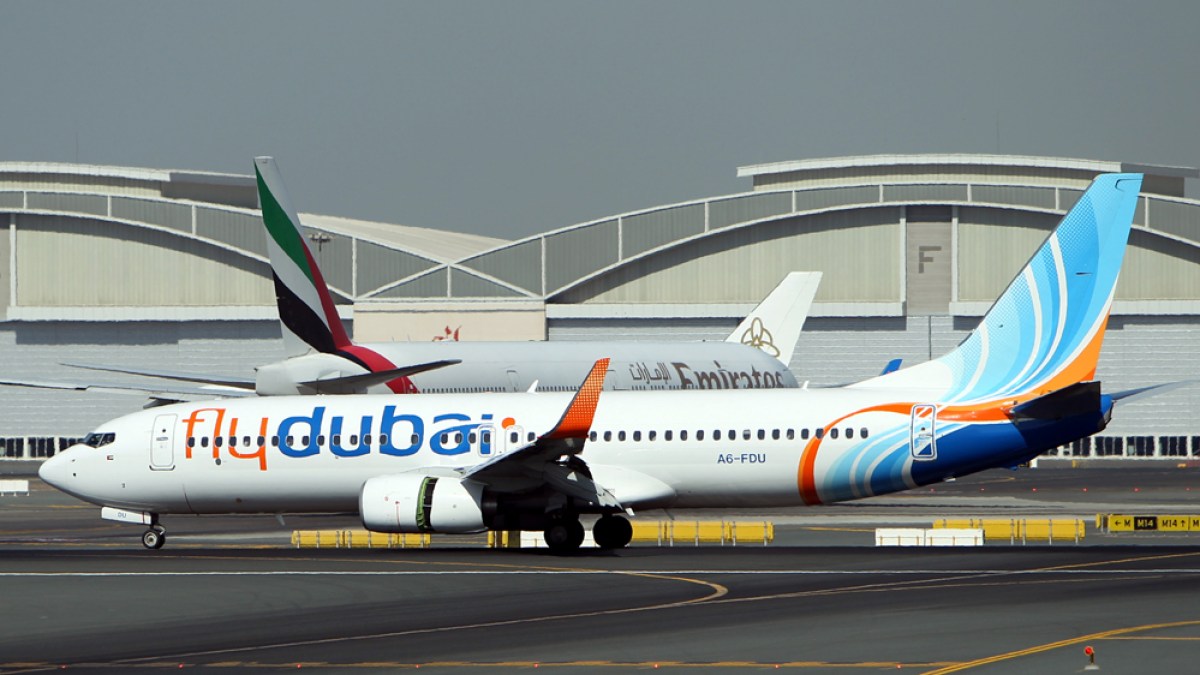
At 07:29 UTC on 30 September 2026, a Flydubai Boeing 737 en route from Dubai to Tel Aviv squawked 7500, the international transponder code reserved for unlawful interference or a hijacking, then minutes later switched to 7700, the general-emergency code. Israeli Air Force jets were scrambled. The aircraft then dropped off public flight-tracking coverage near Tabuk, Saudi Arabia, before reappearing on the same trackers as it diverted to Tabuk Airport, where it landed safely. No passengers or crew were reported injured.
That sequence, reconstructed from a small set of regional channels, captures a contemporary aviation fact: when a code-7500 squawk occurs in the corridor between the Gulf and the Mediterranean, the operational response now stretches across at least three air-defence chains within minutes, and the aircraft can come to rest at a Saudi military-civilian airfield rather than at any of the airports a normal flight plan would name. The incident is small in scale. Its geography, and the way different parts of the regional information ecosystem covered it, are not.
What the available reporting establishes
The most consistent factual spine comes from an Al Jazeera English breaking-news bulletin published at 08:00 UTC, which states that Flydubai confirmed a plane experienced an "incident" en route from Dubai to Tel Aviv and that the aircraft landed safely at Saudi Arabia's Tabuk airport. Kyiv Post's official Telegram channel, posting at 08:05 UTC, identifies a possible mechanism for the diversion in language shared with multiple outlets: the plane's pilots "got into a physical fight and transmitted emergency signals," after which the aircraft landed at Tabuk. The same Kyiv Post post also carries an Israeli official line that the incident "was not believed to be a hijacking," a characterisation that materially qualifies the threat assessment. Tasnim News, Iran's English-language state outlet, posted at 07:56 UTC that the Flydubai aircraft "disappeared from radar screens for a few minutes" before landing at Tabuk, and relayed Israeli media as saying there was "no" further hijacking risk. The earlier channels, including three separate Clash Report posts at 07:08 UTC, 07:39 UTC and 08:10 UTC, and BellumActaNews at 07:29 UTC, all emphasise the 7500-to-7700 transponder sequence, the IAF scramble, and the brief disappearance from flight-tracking coverage. An Iranian-aligned summary from PressTV, timestamped 08:17 UTC, refers to the diversion as caused by a dispute but, in a material departure from the rest of the set, identifies the aircraft as an Emirates flight from Abu Dhabi to Tel Aviv and quotes passengers as claiming the flight was hijacked. The available source items do not specify whether the PressTV post is a parallel report on the same aircraft, a confusion between two flights, or a relay error.
The convergence across the rest of the set is narrow and clear. There was a Flydubai aircraft in the air between Dubai and Tel Aviv at approximately 07:00 to 07:30 UTC. It transmitted 7500, then 7700. It briefly dropped off public trackers. It was met by Israeli fighter jets. It diverted to and landed safely at Tabuk Airport, in Saudi Arabia. The detail that is singular to one outlet, the pilots' physical altercation reported by Kyiv Post, is the kind of claim that, if accurate, will produce a formal aviation-investigation disclosure within days, but the source set does not yet carry a Flydubai corporate statement beyond the single "incident" phrase, a UAE General Civil Aviation Authority release, or a Saudi aviation authority confirmation. The available items specify what the airline said to Al Jazeera in a single phrase, what Israeli officials told Kyiv Post about the hijacking assessment, and what Israeli and Iranian channels relayed; they do not specify a motive, an attacker count, or whether either pilot was detained on the ground in Tabuk. The Emirates-versus-Flydubai discrepancy in the PressTV post is the most consequential unresolved question in the set, and this article treats it as such rather than smoothing it over.
How three information ecosystems framed the same hour
For all the technical clarity, the most telling differences are editorial. The Iranian-aligned channels, PressTV and Tasnim, foregrounded that the aircraft dropped off tracking and that Israeli media subsequently downplayed the threat. The wording in each case is calibrated to put the responsibility for the scramble narrative on Israeli reporting, and PressTV goes further by attributing the diversion to an Emirates aircraft and quoting passengers who said the flight was hijacked, a read that no other source in the set shares. Kyiv Post, whose principal subject is the Russia–Ukraine war and whose MENA coverage is occasional, gave the most specific mechanism for the diversion, citing the pilots' physical altercation, and carried the Israeli "not believed to be a hijacking" line in the same post. The Israeli-channel relay via BellumActaNews, and the longer-running conflict-tracker Clash Report, emphasised the standard procedural elements: the 7500 squawk, the IAF scramble, the 7700 follow-on, the descent, and the safe landing. Al Jazeera English, the only tier-one wire among the set, carried the airline's own characterisation of an "incident" and stopped there.
Monexus analysis: in a corridor where Israeli, Iranian, and Gulf-anchored outlets all have reason to characterise an aviation emergency differently, the technical facts converge while the framing diverges. Israeli-anchored channels lead on procedure, as a matter of professional habit; Ukrainian and other Eastern-European channels, used to seeing Russian air-defence activity in their own airspace, defaulted to the operational cause; Iranian-aligned channels, the most experienced in the region at reading Israeli statements critically, foregrounded the disappearance and the subsequent Israeli reassurance, with PressTV introducing an Emirates-versus-Flydubai discrepancy and a hijacking claim attributed to passengers. The readers of each ecosystem would walk away with a slightly different event. The transponder code, the airport, and the safe landing are common to most reads. The threat assessment is not, and the operator identity is genuinely contested in one part of the set.
The corridor, and why Tabuk
Tabuk is not a routine diversion airport for a Dubai–Tel Aviv flight. The shortest runway footprint for a 737 experiencing an in-flight emergency on that route lies further north, at one of the Israeli airfields with pre-staged IAF rescue posture, or alternatively at Amman, which is closer to the route's midpoint than the Gulf cities. A diversion south to Tabuk implies either a flight path that had already passed the safer northern options, or a reason not to use them. The available source items do not specify which. What they do establish is that the Saudi facility accepted the diversion without an obvious delay, and that the aircraft landed safely under what the Israeli channels described as fighter-jet cover.
The Saudi-Israeli air-corridor normalisation, which accelerated through 2023 and 2024 and has continued under overlapping security and commercial agreements since, makes a Tabuk diversion operationally credible in a way it would not have been a decade earlier. Monexus analysis: the geography of this incident is a small, inadvertent snapshot of the regional architecture. A code-7500 squawk in the airspace between the Gulf and the Levant now triggers a layered response in which Saudi military-civilian infrastructure, UAE-registered commercial aircraft, Israeli fighter jets, and Iranian-allied information channels are all present, in sequence, within an hour. That is the structural fact underneath the small human story of a frightened flight, and the PressTV discrepancy is itself a reminder that the regional information environment is still uneven enough for the same hour to produce two different operator identities and two different threat narratives.
What the reporting does not yet say
A number of consequential details are missing from the source set, and this article treats that absence as a real feature of the available reporting rather than as a fact in itself. Flydubai, the operator named by every source except PressTV, has so far spoken only through the single phrase Al Jazeera carried at 08:00 UTC: that there was an "incident." The UAE General Civil Aviation Authority has not, in the available items, issued a statement. The Saudi aviation authority has not, in the available items, confirmed or denied receiving the diversion. Israeli Air Force public-affairs outputs in the set are limited to the relay channels and to the "not believed to be a hijacking" line carried by Kyiv Post; no IDF Spokesperson briefing on the scramble is present in the items at the time of writing. No passenger manifest, no count of injuries, and no indication of whether either pilot was detained or released at Tabuk is contained in the sources cited above. Kyiv Post's pilot-altercation account is the strongest causal claim in the set and the one most likely to be tested by a formal investigation; this article does not assert it as established, and the same Kyiv Post post explicitly carries the Israeli official position that the incident was not believed to be a hijacking, which sits in tension with the pilots-fight framing rather than reinforcing it.
The PressTV discrepancy is the single most consequential unresolved question. Either PressTV is relaying a separate, parallel Emirates flight from Abu Dhabi to Tel Aviv that diverted to Saudi Arabia on the same morning, an event that would be a genuinely separate incident rather than a competing account of the Flydubai flight, or it has misidentified the operator. The available source items do not specify which. If PressTV's account is independent, then within a roughly 90-minute window two Gulf carrier flights registered transponder emergencies on the same corridor and both diverted to Saudi Arabia, which would be a far larger story than the Flydubai flight alone. If it is a misidentification, then the hijacking claim attributed to passengers should be discounted. The available items do not allow this article to choose between those two reads.
The forward-looking questions are narrow and concrete. A Flydubai corporate statement is the next most likely disclosure, typically within 24 to 72 hours of a commercial incident involving a transponder emergency; it should also clarify whether the pilots were a two-person flight crew and whether any crew action preceded the 7500 squawk. An Emirates statement is the second priority, given the PressTV discrepancy. A Saudi aviation authority confirmation, if it comes, will clarify whether Tabuk was chosen by the crew, by Israeli vectoring, or by Saudi acceptance of a pan-priority request. An IAF debrief, if released, will settle the timeline of the scramble and whether the 7500 squawk was active for more than the seconds-to-minutes range the relay channels imply. Until at least one of those records appears, the strongest claim this article can sustain is the technical convergence across most of the set: 7500, 7700, Tabuk Airport, safe landing, IAF in the air, Israeli officials publicly framing the event as not a hijacking. Everything else is reported, not confirmed, and the Emirates-versus-Flydubai discrepancy in the Iranian-aligned coverage is the cleanest demonstration of how thin the available record still is.
Desk note: Monexus framed this from a tier-one wire baseline (Al Jazeera English), the most specific causal claim in the set (Kyiv Post's pilot-altercation account), and the Israeli official line carried in the same Kyiv Post post that the incident was not believed to be a hijacking. Iranian-aligned and Israeli-anchored coverage appears as parallel counter-frames rather than as primary evidence, and the PressTV Emirates-versus-Flydubai discrepancy is foregrounded as a material unresolved question rather than smoothed away. The structural read is the corridor itself: a code-7500 squawk that lands at a Saudi airfield, with Israeli jets overhead and Iranian-aligned channels pushing both the threat assessment and the operator identity in a different direction, is a small but legible image of how Middle Eastern aviation, security, and information ecosystems now overlap.
Wire provenance
This editorial synthesis draws on the following public wire/social posts:
- https://www.aljazeera.com/news/2026/9/30/flydubai-flight-to-israel-diverted-to-saudi-arabia-after-emergency-alert?traffic_source=rss
- https://t.me/Kyivpost_official/40372
- https://t.me/ClashReport/98980
- https://t.me/ClashReport/98976
- https://t.me/ClashReport/98973
- https://t.me/BellumActaNews/177414
- https://t.me/tasnimnews_en/39740
- https://t.me/presstv/208918
Follow the event.
These dated source records provide context. They do not retrospectively verify this archive article.
Separate what the nuclear watchdog reported from what it could not determine after the June 2025 strikes.
- https://www.aljazeera.com/news/2026/9/30/flydubai-flight-to-israel-diverted-to-saudi-arabia-after-emergency-alert?traffic_source=rss
- https://t.me/Kyivpost_official/40372
- https://t.me/ClashReport/98980
- https://t.me/ClashReport/98976
- https://t.me/ClashReport/98973
- https://t.me/BellumActaNews/177414
- https://t.me/tasnimnews_en/39740
- https://t.me/presstv/208918