Bahrain Is Getting Hit, and the Coverage Isn't Keeping Up
Within a single hour on 8 July 2026, Iranian missile and drone volleys forced at least four waves of air-defence activation over Manama. The wire desks barely noticed — and that silence is itself the story.
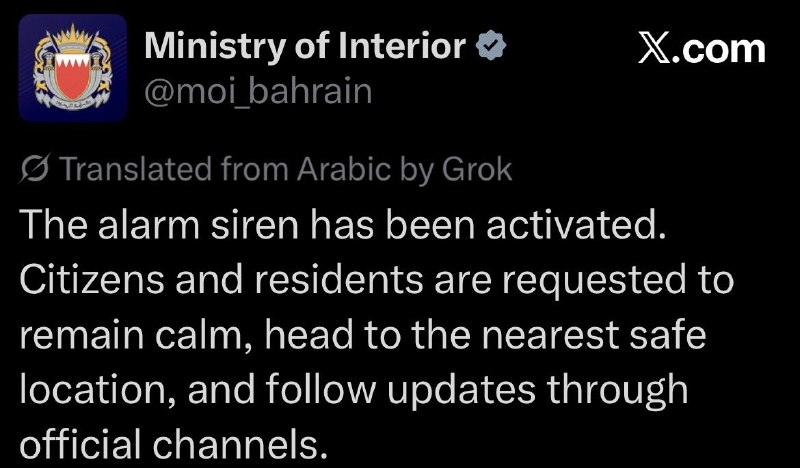
At 02:12 UTC on 8 July 2026, Manama's air-defence network lit up for the first time in a barrage that, by 03:24 UTC, had rolled through at least four distinct waves of Iranian-launched missiles and drones. Bahrain's Ministry of the Interior told residents to seek shelter. Sirens wailed across the capital. Interceptors streaked upward. And the major Western wire services, the ones whose headlines shape the day's editorial priorities in Washington, London, and Brussels, were not on the story.
That gap between an unfolding military event and the editorial attention it commands is the more honest lede than the strikes themselves. Bahrain sits host to the US Fifth Fleet and the combined maritime forces of roughly forty nations. It is, by any measure of force projection, one of the most strategically valuable pieces of real estate on earth. A country under repeated bombardment, defended in real time by American and partner systems, ought to be the easiest story in the world to cover at volume. It is being covered at a whisper.
What the open-source record actually shows
The OSINT layer was dense. At 02:44 UTC on 8 July 2026, the OSINTdefender feed flagged the wave as it began, citing the Interior Ministry's shelter directive and the activation of alarm sirens. By 03:13 UTC, observers were counting a fresh batch of explosions over Manama and describing air-defence activity attempting to interdict incoming missiles and drones. At 03:14 UTC, footage surfaced of repeated interceptions; at 03:20 and 03:21 UTC, separate channels confirmed a renewed wave; by 03:23 UTC, the fighting was being catalogued as a "fresh wave of Iranian strikes"; at 03:24 UTC, Bahrain's air-defence network was reportedly reactivated yet again. Geolocation posts traced debris and intercept bursts to the skies above the capital. The pattern was consistent across at least five independent Telegram channels reporting from the Gulf, each relaying eyewitness video, siren audio, and Interior Ministry advisories.
What the open-source record does not yet contain is a precise count of incoming projectiles, a confirmed intercept tally, or an official Iranian statement of authorship. Bahraini authorities had not, by 04:00 UTC, released casualty figures or structural-damage assessments; no Iranian state outlet tracked here had formally claimed the operation. The strikes are real and corroborated by video. The casualty bill is not.
Why the wire desks are quiet
There are three plausible reasons the major services are not pushing Bahrain to their front pages, and they are not mutually exclusive. The first is competition for attention: the same overnight hours carried developments in several other theatres, and Bahrain is, in raw casualty terms, not yet producing the numbers that get a Gulf story past the global desk's threshold. The second is the perennial problem of attribution lag: until an Iranian source — whether the IRGC, the regular armed forces, or a political lead — names the operation publicly, Western editors tend to wait. The third, and the one least spoken about, is the patronage structure of the story. Bahrain is a small kingdom. Its audience on any major Western platform is limited. Its strategic importance is high; its perceived readership value is low.
A competing read is that the silence is more innocent: that desk editors simply have not yet caught up with the open-source feed, and that within hours the wire will move. That is the optimistic version. The pessimistic version is that this is what Bahrain looks like in the Anglo-American press cycle when it is hit — present in OSINT chatter, absent from editor's picks, available for citation but not for prominence.
What the pattern means in plain terms
The asymmetry is not new. It is the same mechanism that decides which conflicts get prime real estate on the homepage and which end up filed under "world news, lower down." The deprioritisation is structural, not editorial malice: editors ration attention, and they ration it by expected reader interest. Bahrain is small, distant, and not English-speaking; its airstrikes lack the narrative scaffolding — occupation, insurgent movement, a famous capital in ruins — that lifts a war into the front-page tier.
There is also a counter-narrative worth airing. Iran, for its part, frames its strikes through the regional command structure it has spent two decades constructing, and through a doctrine of calibrated escalation that aims at political signalling rather than regime change. Read that way, the volleys over Manama are not indiscriminate punishment; they are communications with a real audience in mind — Riyadh, Abu Dhabi, Washington, Tel Aviv. Within that framing, the strikes carry a logic the casualty counts alone do not capture. Whether that logic holds or whether it is post-hoc rationalisation depends on what comes after the last interceptor falls.
The stakes, plainly stated
If the pattern continues, Bahrain becomes the template for a particular kind of 21st-century war: visible to anyone watching the right Telegram channel, invisible to anyone reading only the front pages. That is bad for residents under fire, who deserve the same global attention as anyone else, and bad for the policy class, which consistently under-weights events it does not see. It is also bad for the West's own regional posture. The Fifth Fleet does not function as a deterrent if the local population being defended goes unaired.
The sources disagree on what is happening on the ground, in the most literal sense. The interception count is unclear; the casualty count is unknown; the Iranian authorship is not, as of this writing, formally confirmed by Iranian state media in the open record. What is not contested is that Manama was, for at least seventy minutes, a city under fire with air-defence batteries firing across multiple salvos, and that the country's own government told its people to take shelter. That part is documented. The rest will fill in over the coming hours.
This publication flagged Bahrain as the active flashpoint of the Iranian overnight campaign at 03:30 UTC; the wire desks had not picked it up. By the time they do, the headlines will read like confirmations of what the open-source feed already knew.
Wire provenance
This editorial synthesis draws on the following public wire/social posts:
- https://t.me/intelslava/19768
- https://t.me/rnintel/41102
- https://t.me/GeoPWatch/95217
- https://t.me/AMK_Mapping/32874
- https://t.me/osintlive/62219