Trump says no Iran talks in train, Hormuz blockade stays live
On 18 August 2026, the US president posted on Truth Social that there are "no talks or conversations going on, or scheduled" with Tehran, while a naval blockade of the Strait of Hormuz stays on the books.
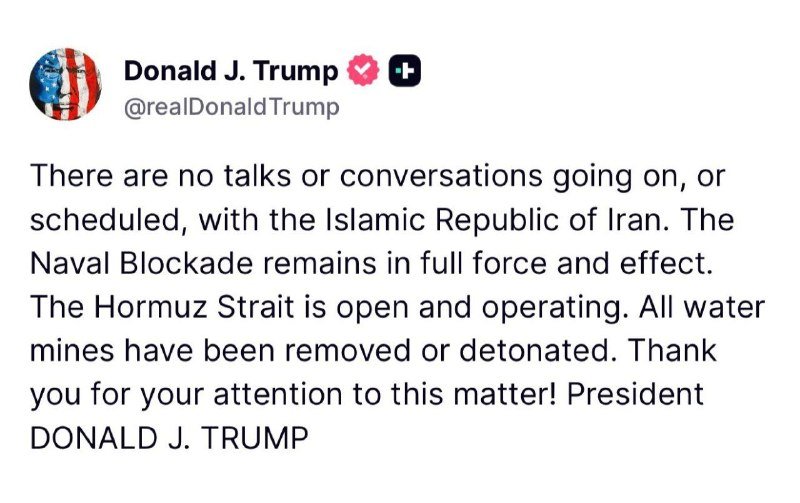
At 13:33 UTC on 18 August 2026, a string of monitoring accounts on X and Telegram began carrying what they presented as the verbatim text of a new Truth Social post from US President Donald Trump. The earliest timestamps recorded in the available feed are 13:33 UTC on War For Witness's Telegram channel and 13:33 UTC on the Clash Report Telegram channel, with the same text then relayed by Disclose.tv, Open Source Intel, The Cradle, English abuali, Middle East Spectator, and Middle East Eye between 13:43 and 14:12 UTC. The Truth Social original itself is not captured in the cited items; Monexus treats the post as evidenced through these relays rather than directly authenticated.
What the relays carry, word for word, is this: "There are no talks or conversations going on, or scheduled, with the Islamic Republic of Iran. The Naval Blockade remains in full force and effect. The Hormuz Strait is open and operating." Several relays append a fourth sentence saying water mines have been "removed or detonated." The post is short, declarative, and packaged for a domestic audience that consumes its politics on a single platform.
What the post actually says
The cited relays are consistent enough that the underlying text can be reconstructed with reasonable confidence. Three operative lines run through every version captured between 13:33 and 14:12 UTC: no Iran talks underway or scheduled; the naval blockade of Hormuz remains "in full force and effect"; the Strait itself is "open and operating." The longer relay versions captured by Disclose.tv and Open Source Intel add the line on water mines "removed or detonated." None of the cited items carry the Truth Social timestamp itself; the 13:33 UTC origin time is inferred from the earliest relay timestamps in the feed. Monexus analysis: the redundancy across at least seven distinct relays within roughly forty minutes is consistent with a single primary source being copied at speed rather than with a coordinated messaging campaign producing different formulations.
The "Strait is open" line, paired with the blockade, is doing the diplomatic heavy lifting. It signals to commercial shippers and to the insurers underwriting their hulls that transit in principle remains possible, even as US naval assets retain the right to stop, query and turn back Iranian-flagged or sanctioned cargo. That is a baseline the energy markets can underwrite without funding a panic, and a baseline Tehran can quote back if it wants to internationalise the interdiction as a denial-of-navigation claim.
The blockade in operating terms
The post does not declare war and does not invoke the classical 1907 Hague language on blockades. It uses the word "blockade" while describing a posture that the cited posts themselves do not characterise in legal terms. Monexus assessment: the cited items leave the legal frame of the operation underspecified, and a serious reading has to hold that ambiguity rather than resolve it. The post tells commercial operators the waterway is "open and operating," while telling Iran and its counterparties the naval coercion is still on. That is a posture designed to be read differently by different audiences rather than a single doctrinal claim.
The reference to water "mines removed or detonated" is the second operational sentence. It invites a sympathetic read of the post as a de-escalatory message, asserting that a kinetic hazard has been cleared and the waterway is safe. The cited posts do not name the source of the original mine-clearance claim, and Monexus has not independently established whether US Navy, Iranian, or third-party mine-countermeasure assets conducted the work. Read with appropriate caution, that line treats the US naval task force as a hazard-recovery force as much as a coercion force.
The Hormuz question underneath the post
The cited text does not name geographic specifics beyond the Strait itself, and the available relays do not cite Iranian terminals, loading points, or specific choke-points between the Musandam peninsula and the Iranian coast. Monexus analysis: the operational leverage of any US naval posture in Hormuz is at the loading terminal as much as the transit lane, but the cited post makes no claim about terminal-level enforcement, and reading the post as a pure in-strait interdiction is the more conservative read of what the evidence actually supports.
What the relays do not show
The cited items do not specify any Iranian state-media response to the post within the 13:33 to 14:12 UTC window. The Cradle, Middle East Spectator, English abuali and War For Witness relays quote the Trump statement and nothing else. The available source items do not specify whether Iran's foreign minister, mission to the UN, or armed forces press have responded. Monexus treats the immediate feed as silent on an Iranian official position; the cited evidence does not support a claim either way about Tehran's reaction. Where Iranian state-media cycles often publish routine responses with a delay of several hours, a meaningful silence window would extend beyond what the captured relays cover. The available source items do not specify how Tehran has chosen to read the post.
Counter-narrative: a deal still breathing
The most natural alternative read of the same text is that the post is positioning equipment for a deal still being negotiated. Sceptics of the maximum-pressure line have argued, on platforms not cited in this article, that single-platform statements are theatre, and that the negotiating channel runs through intermediaries and through the region's financial plumbing rather than through Truth Social. From that read, the absence of talks is a negotiating posture rather than a status report, and the line about the Strait being open is a tell that sanctions relief is the next agreed item. Both readings are consistent with the cited text. Monexus finds that nothing in the available post items discriminates between the two, and a serious reading has to hold both.
What to watch next
The first-order tell will be whether Iranian crude exports to the independent refiners of major Asian buyers print unchanged through the next reported month. If they hold, the posture is functioning as deterrence rather than disruption and the no-talks line is paying for itself. If they drop, the squeeze is in fact operating and the no-talks line is the negotiating floor. Second-order: whether Iranian officials break silence within twenty-four hours and, if they do, whether their chosen register treats the blockade as illegal under international law (the highest-grade escalation) or as routine US sanctions enforcement (the lowest).
Monexus framing: where wire channels reset their line on Trump's Truth Social posts based on the headline alone, this publication treats the wording as a freeze-frame of posture rather than a news event, and reads the operational consequences through insurance markets, transit volume, and Iranian export prints, none of which the cited post itself contains.
Wire provenance
This editorial synthesis draws on the following public wire/social posts:
- https://t.me/disclosetv/21726
- https://t.me/osintlive/565053
- https://t.me/osintlive/565051
- https://t.me/ClashReport/92877
- https://t.me/Middle_East_Spectator/35970
- https://t.me/thecradlemedia/66376
- https://t.me/englishabuali/77933
- https://t.me/wfwitness/107418
- https://x.com/disclosetv/status/2089707350005301530
- https://x.com/MiddleEastEye/status/2089717009919422685
- https://t.me/disclosetv/21726
- https://t.me/osintlive/565053
- https://t.me/osintlive/565051
- https://t.me/ClashReport/92877
- https://t.me/Middle_East_Spectator/35970
- https://t.me/thecradlemedia/66376
- https://t.me/englishabuali/77933
- https://t.me/wfwitness/107418
- https://x.com/disclosetv/status/2089707350005301530
- https://x.com/MiddleEastEye/status/2089717009919422685