Hichilema keeps Zambia, but the opposition's stronger-than-expected finish narrows his mandate
Zambia's president has won a second term with a comfortable lead, but an unexpectedly strong opposition showing on the back of public frustration with continuing hardship reads as a constraint on his second-term agenda rather than a clean victory.
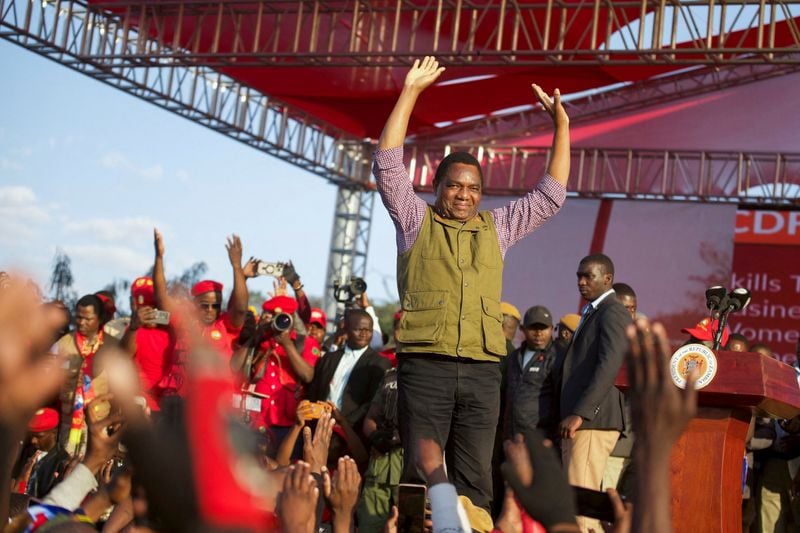
Zambia's electoral commission declared President Hakainde Hichilema the winner of a second term on Tuesday, 18 August 2026, with the 64-year-old incumbent campaigning on his record of economic recovery, including a major debt restructuring deal. The headline result is a comfortable win. The subheadline is the one to watch: the main opposition put in an unexpectedly strong showing, capitalising on public frustration with lingering hardships, and the shape of that result is the constraint on the government's second-term agenda.
Hichilema's re-election is a story of two economies. The macroeconomic one is better than it was when he took office. The household one is not, and the opposition nearly punished him for it. Read together, the result is a mandate, a warning, and a negotiating position, all at once.
The macro story that powered the win
The campaign could, with some justification, run on recovery rather than on promises. France 24 reported that Hichilema won after campaigning on his record of economic recovery, anchored by the debt restructuring that defined his first term and by a message that the worst of the 2021-era crisis had been put behind the country. The New York Times framed the result as a hard-fought re-election after a tumultuous campaign, in which the president made the case that macroeconomic stabilisation had earned him another five years.
The numbers that mattered to investors and creditors, the debt-to-GDP trajectory, the return to international capital markets, the IMF programme, were real. The numbers that mattered to voters at the till, in food and fuel lines, were not as clearly improved, and the opposition's stronger-than-expected finish suggests the macro-versus-household gap is now the binding constraint on the government's second-term agenda.
The opposition nearly punished him for it
Reuters reported that the opposition put in an unexpectedly strong showing, capitalising on public frustration with lingering hardships despite Hichilema's win. France 24's reporting framed the vote as won on big economic promises rather than on a settled record, which is a different reading of the same numbers: the incumbent held, but on a forward-looking pitch, not a backward-looking one. The available source items describe the opposition's performance as 'unexpectedly strong' but do not specify the final margin or share of the vote in the cited posts, and this article has not independently established either. Monexus analysis: an unexpectedly strong opposition finish consistent with public frustration, ahead of a five-year programme that still requires multilateral buy-in, is the politically meaningful signal in the result, separate from the exact vote share.
The pattern is familiar across the region: a reformist incumbent who tames the deficit is still vulnerable to the voter who cannot see the bond prices improve at the checkout. The opposition's surprisingly strong finish is therefore more useful analytically than the headline re-election. It tells Lusaka that the recovery story has a shelf life, and that the next five years will be measured at the till, not in debt-to-GDP tables.
Why Washington is reading this one closely
The New York Times noted that, with a second term, Hichilema must navigate relations with the Trump administration, which has sought greater access to Zambia's copper-rich natural resources. That is the immediate external pressure point on the new term, and it arrives while the macro stabilisation programme still requires multilateral buy-in. The available source items do not specify the current state of US-Zambia negotiations, nor whether any specific minerals-access agreement has been signed, and this article has not independently established either.
The structural logic is straightforward. Zambia is a copper-rich nation, and whoever sits in Lusaka shapes how much of that resource base moves through which buyers, under which contractual terms, and with what share of value captured domestically. The result is that Hichilema enters his second term holding more leverage than the vote share alone suggests, because both Washington and Beijing have reasons to want him stable, and an unexpectedly strong opposition finish has not changed that calculation.
What the second term actually has to deliver
The forward programme is heavy. A continuing IMF programme that the source items do not detail beyond the broader debt-restructuring reference. The pressure that France 24 identified explicitly: jobs, poverty, and the charge from critics that the government is becoming less tolerant of dissent, all of which the opposition's stronger showing has now raised as defining metrics of the second term. And a regional environment in which Zambia's copper, and the corridors that move it to Atlantic and Indian Ocean ports, sit at the centre of a US-China competition that did not exist in the same shape five years ago.
Hichilema's mandate is real. The opposition's strong showing is also a constraint. Lusaka will be negotiating with Washington, Beijing, and the IMF at the same time, and the voters who nearly cost him this term will be watching the negotiation at the checkout, not the press conference.
Monexus framed this as a cost-of-living story wearing a debt-restructuring suit, leaning on wire and African correspondent reporting rather than on Western foreign-policy framing alone.
Wire provenance
This editorial synthesis draws on the following public wire/social posts:
- https://www.nytimes.com/2026/08/17/world/africa/zambia-election-hichilema.html
- https://reut.rs/4wvvBf5
- https://x.com/Reuters/status/2089532765330874856
- https://www.france24.com/en/africa/20260818-zambia-president-hichilema-wins-re-election-with-big-economic-promises
- https://t.me/france24_en/18253