Google Maps relabels Lake Ontario as 'Lake America' for US users, leaving Canada with the old name
Google Maps began showing US users 'Lake America' on 30 August 2026, with Canadian users retaining 'Lake Ontario' and the rest of the world seeing 'Lake Ontario (Lake America)'. The rollout is the first major platform implementation of a Trump-era executive order renaming the lake.
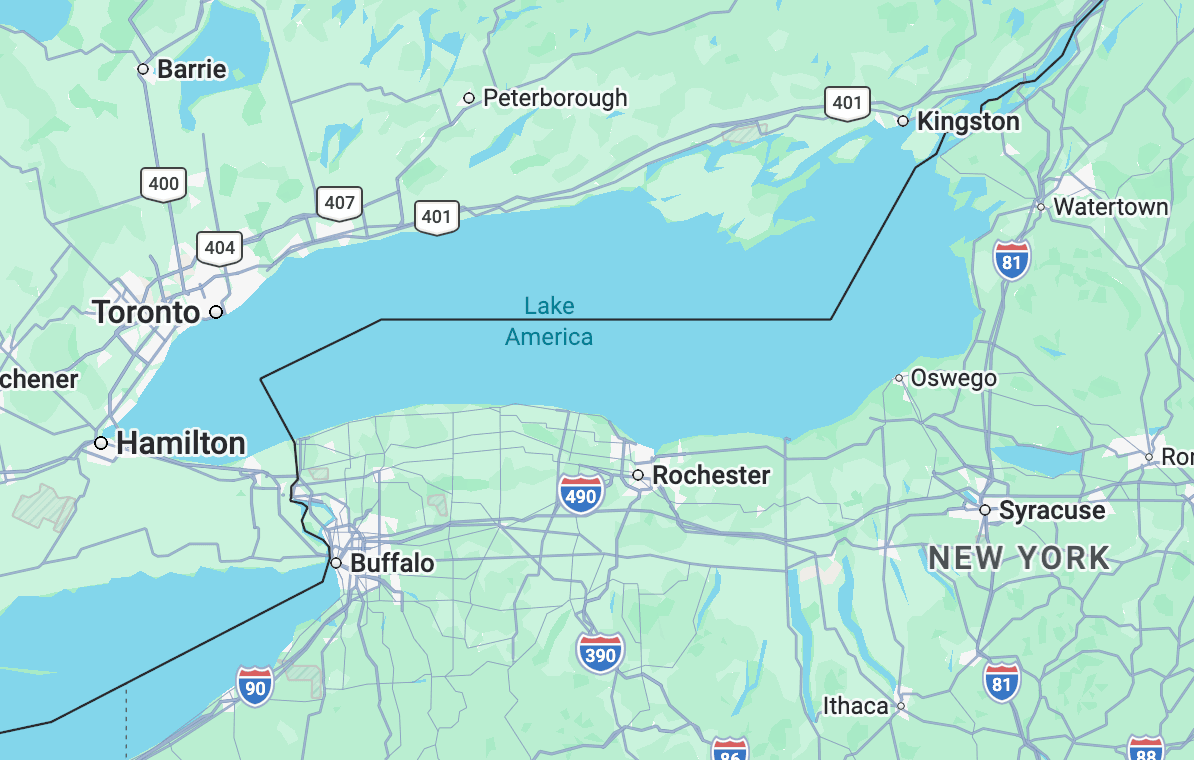
At 16:16 UTC on 30 August 2026, Wired reported that Google Maps had begun displaying the body of water between the United States and Canada as 'Lake America' for American users, the first major online maps provider to act on a Trump executive order demanding the rename. Investing.com carried the same headline under neutral wire copy, 'Google Maps will show 'Lake America' in US, not 'Lake Ontario''. Screenshots of the new label propagated across X within hours, and the prediction market that had tracked the move posted its follow-through to its account at 22:55 UTC the same day.
The story underneath the screenshot is not really about a lake. It is about who controls the labels on the world's most-used map product, and what happens when a sovereign rename collides with the operational logic of a transnational platform. Google, for now, is splitting the difference: the rest of the world sees 'Lake Ontario (Lake America)', while Canadian users keep the original name. The compromise reveals a company reading the room for both legal exposure and reputational risk on both sides of the border.
The order and the rollout
Wired described Google as 'the first major online maps provider to flip the switch' after the executive order demanding the name change, and the relabel was already visible to US users by the time the story filed. Investing.com matched the framing in market-facing prose, treating the change as a discrete platform update rather than a political event. The Polymarket account confirmed the geographic carve-out within hours of the rollout: Canadian users retain 'Lake Ontario', and the rest of the world sees the hybrid 'Lake Ontario (Lake America)'.
Google's tiered cartography, one label for US users, another for Canadians, a parenthetical for everyone else, is the more revealing product decision. Maps have long been instruments of sovereignty, but the speed at which a private platform can now operationalise a sovereign preference, and the precision with which it can target a single national user base, is a function of the platform era.
Why Google moved first
Wired explicitly singled out Google as the lead mover, and the Polymarket account's morning post framed Google as the platform that had 'officially relabel[ed]' the lake for US users. The available reporting identifies Google as the first major maps provider to act; the available source items do not specify Apple Maps' status, and this article has not independently established whether Apple has followed, declined, or is still reviewing the rename. The Polymarket X account's second post on 30 August treated the geographic segmentation, not the platform count, as the operative detail.
The political wager embedded in the executive order is that geographic naming is a low-cost sovereignty play: cheap to announce, enforceable against federal contractors, and visibly responsive to a domestic constituency that reads the rename as a corrective. The wager's downside is foreign policy. Canada's response has run through visible acts of refusal rather than reciprocal platform leverage, and the Investing.com wire's neutral framing, treating the change as a manageable irritant rather than a rupture, holds only as long as the relabel stays symbolic. If federal procurement pressure extends to cross-border data products, navigational charts, or hydrographic services, the conversation shifts from branding to operational coordination.
The prediction market had already priced it
The Polymarket contract on whether Google Maps would rename the lake by year-end sat at 96% the day before the rollout, posted to X at 20:37 UTC on 29 August 2026. Monexus analysis: prediction markets are now functioning as a faster, more granular barometer of corporate compliance than the press cycle. By the time Wired and the wires wrote the story, the rename had been priced and the only remaining question was the implementation detail, the geographic carve-out, which Polymarket flagged within hours of the relabel going live.
That detail matters more than the headline. The decision to preserve 'Lake Ontario' for Canadian users is the kind of granular jurisdictional carve-out that a prediction market can isolate but a press release cannot capture. Polymarket's follow-up post, noting that 'Canadian users will still see Lake Ontario, while the rest of the world will see 'Lake Ontario (Lake America)'', captures the operational architecture of compliance rather than the announcement.
The structural frame
Geographic naming has always been a soft-power instrument. The question this episode surfaces is whether the locus of that instrument has shifted from treaties and gazetteers, where it sits on a multi-year diplomatic clock, to executive orders and product roadmaps, where it sits on a sprint cycle. Monexus assessment: the more interesting story is not the lake but the pipeline. An order lands, a platform operationalises it, a prediction market confirms it, and the diplomatic back-channel learns of it through screenshots forwarded by users on a messaging app.
The asymmetry is starker than the substance. Washington can move at the speed of an executive order; Canada's available response, within the cited sources, runs through visible public refusal rather than reciprocal platform leverage. Platforms ship the change before either capital has finished its communications. The structural read is that cartographic sovereignty is becoming a platform-governance problem as much as a diplomacy problem, and the platforms, not the foreign ministries, are now the first venue in which the result becomes visible to ordinary users.
What to watch next
Three concrete forward indicators. First, Google Maps itself: the available source items do not specify whether Google has published communications on the GNIS (Geographic Names Information System) basis for the change; that detail will shape whether other federal contractors treat the rename as a compliance baseline or as a one-platform accommodation. Second, Apple Maps and other providers: the available source items do not specify whether Apple has acted; that absence will itself become a signal once the next 48 to 72 hours pass. Third, USMCA consultations expected to open in Ottawa in the period following this story, where hydrography, Great Lakes water-levels data, and border-infrastructure funding will sit alongside the lake rename as backdrop even if no negotiator puts the label on the agenda.
The lake itself has not changed. The labels on the map have, and the labels are now a faster, cheaper instrument of policy than any treaty that came before them.
Desk note: Monexus framed the story around the platform-governance architecture and the asymmetry between the US platform rollout and Canada's visible refusal, rather than the partisan backstory of the executive order. Wire ledes emphasised the rename; the structural read is that the rename is the visible artefact of a much faster sovereign-compliance cycle than either capital is currently built for, and that prediction markets now price the next platform concession before the press cycle writes it. The Canadian political response, including any official statements from Ottawa or provincial capitals and any visible counter-signage at the lakeside, is not specified in the cited source items and is left for separate verification.
Wire provenance
This editorial synthesis draws on the following public wire/social posts:
- https://www.wired.com/story/google-maps-now-shows-lake-america-instead-of-lake-ontario/
- https://www.investing.com/news/stock-market-news/google-maps-will-show-lake-america-in-us-not-lake-ontario-4882054
- https://x.com/Polymarket/status/2094197380199448617
- https://x.com/Polymarket/status/2094084806535454724
- https://x.com/stats_feed/status/2094119577453994064
- https://x.com/Polymarket/status/2093800128163332199
- https://poly.market/lEL3tMS
- http://nitter.perennialte.ch/Polymarket/status/2094084806535454724
- https://www.wired.com/story/google-maps-now-shows-lake-america-instead-of-lake-ontario/
- https://www.investing.com/news/stock-market-news/google-maps-will-show-lake-america-in-us-not-lake-ontario-4882054
- https://x.com/Polymarket/status/2094197380199448617
- https://x.com/Polymarket/status/2094084806535454724
- https://x.com/stats_feed/status/2094119577453994064
- https://x.com/Polymarket/status/2093800128163332199
- https://poly.market/lEL3tMS
- http://nitter.perennialte.ch/Polymarket/status/2094084806535454724