Google Maps now shows 'Lake America' to U.S. users. The split-screen rollout is the story.
After a presidential directive on naming, Google Maps now displays 'Lake America' to U.S. users while Canadian accounts keep Lake Ontario. The two-track display is the operational consequence, and the platform-governance test case.
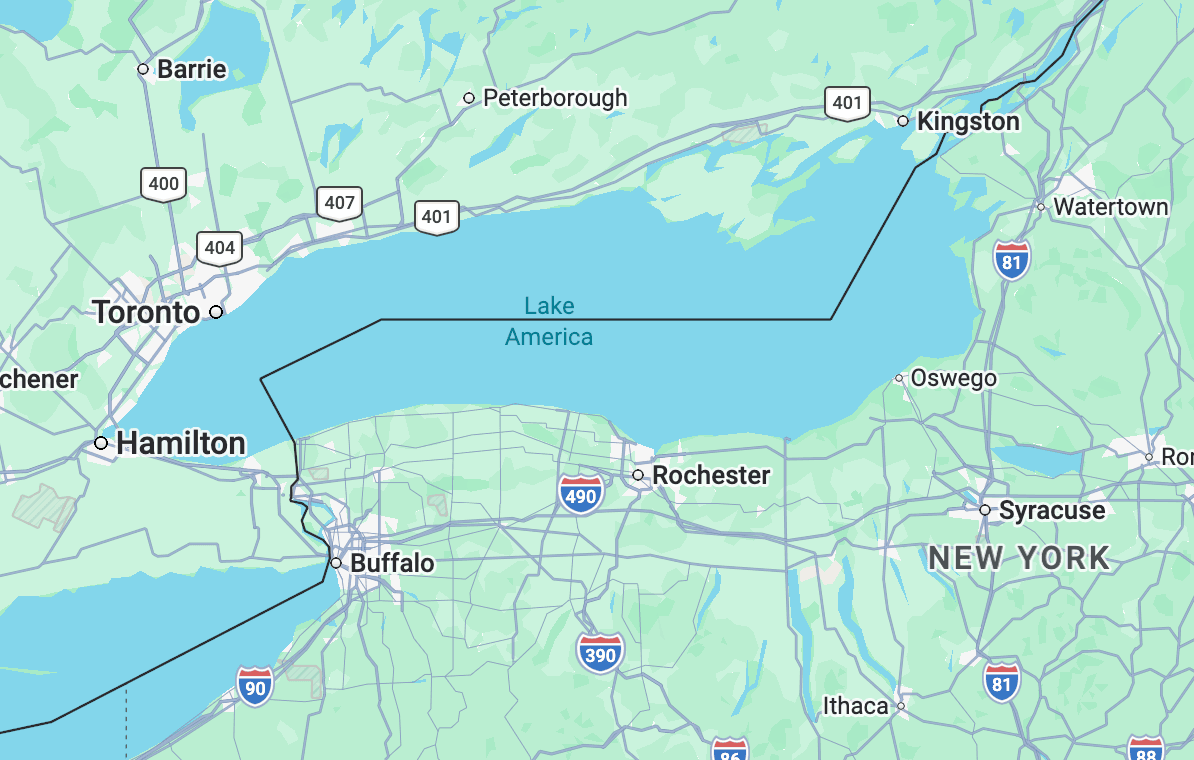
At 11:06 a.m. Eastern Time on 30 August 2026, a search for the easternmost of the Great Lakes on Google Maps returned the label "Lake America" for users inside the United States. Canadian accounts, opening the same application seconds later, saw Lake Ontario. The discrepancy, screenshotted across X and confirmed in reporting by WIRED, is the operational consequence of an executive order signed by Donald Trump and the first major mapping platform to execute it.
The product change is small in geographic terms and large in governance terms. Online maps are no longer passive atlases; they are administrative surfaces. When a private company can flip a toponym on a billion devices because a head of state issued a directive, the question of who writes the legend on the world has moved from cartography into platform policy.
A name change with two audiences
WIRED reported on 30 August 2026 that Google was the first major online maps provider to act on the executive order. A post on X the same day from prediction-market account Polymarket drew a jurisdictional line: Canadian users see Lake Ontario, while everyone outside Canada sees "Lake Ontario (Lake America)" in parentheses, or "Lake America" outright, depending on locale and region settings. Investing.com's stock-market desk confirmed the U.S.-only relabel in the same news cycle.
That two-track display is the detail with the longest tail. A single body of water, straddling the U.S.–Canada border, is now identified differently depending on which side of the 49th parallel the device believes the user to be standing. The lake has not moved. The polygons in Google's geographic database still trace the same shoreline. What changed is the label painted on top of those polygons.
The most natural read is that Google has chosen not to apply the U.S. label where it would generate a diplomatic collision. This publication's assessment is that the split reads less like an editorial decision than a routing rule: the product surfaces whatever the user's locale suggests will not generate a regulatory or political problem that day.
What Google actually decided
Monexus analysis: the more revealing question is what Google did not do. The company did not renumber addresses, redraw U.S. county lines, or re-letter post offices in the source material reviewed here. It did exactly one thing: swap the placename label for a body of water. That narrowness of action is itself a signal. The executive order named this feature specifically, and Google executed at the documented scope and nothing more.
Polymarket traders, who put a 96 percent implied probability on the rename happening by year-end before it landed, treated the outcome as priced in. The trading interest was less about whether the change would occur than about the willingness of mapping platforms to absorb political direction. With Google having moved, the question shifts to whether Apple Maps, Mapbox, Microsoft Bing, Here Technologies, and OpenStreetMap's consumer front-ends will follow, or will route around the U.S. edition as Google has routed around Canada.
There is an unstated alternative read worth naming. Google could have relabelled the lake globally, on every device, in every locale, the way it shows a single neutral name for uncontested features. It did not. The company instead built a jurisdictional fork inside its own product. That choice tells the reader that the platform now treats a sovereign directive as a localised variable, applied where the directive is sovereign, suppressed where it is not.
Maps as administrative infrastructure
For most of their history, online maps were treated as a rendering of neutral geography: mountains, rivers, lakes, the lines that demarcate them. That fiction has been fraying for years. Mapping platforms already adjust contested names by region. The Sea of Japan is also the East Sea in Korean-locale views. The Persian Gulf and the Arabian Gulf coexist in different markets. Crimea is shown differently depending on whether the user is routed through a Russian or Ukrainian server, a choice Google has acknowledged publicly in the past.
What makes Lake America a more consequential case is the trigger: a sovereign directive, not a decades-old naming convention. The company is now a publisher in the literal sense, with a head of state's pen acting as its copy desk. The corporate reflexes that follow from this are predictable. Legal teams will start producing internal matrices that map each executive order to the precise cartographic feature it touches. Policy communications staff will pre-write hold statements for every future "rename moment." The product team will build a localised-name registry with audit trails. None of this is hypothetical; this is how platform governance already works for disinformation, election integrity, and content moderation. Geographic naming is the next tier of the stack.
The harder problem is what happens when two lawful orders collide. State and federal authorities in the United States have, in recent years, diverged on net neutrality, vehicle emissions, and digital-age speech. If a state government were to direct a mapping platform to display a name the federal government has forbidden, the platform would face the kind of jurisdictional conflict that courts, not engineers, decide. That scenario is not in front of the company today. It is the next load-bearing wall, however.
What to watch next
Three things are worth tracking over the next 30 to 60 days. First, whether Apple Maps follows Google's lead; Apple has historically deferred to host-country conventions and would be the most likely second mover. Second, whether Ottawa escalates. The available source items do not specify a formal Canadian government response; whether one is issued, and at what diplomatic altitude, will calibrate how lasting the U.S.-only display rule is. Third, what naming registers the major navigation providers adopt as their default. A memo from the U.S. Board on Geographic Names will likely be upstream of Google's choice. The dataset of names that all platforms share may resolve the question, or entrench the split.
The Polymarket contract that traded at 96 percent before resolution effectively closed the question at a price that left little room for surprise. The interesting trade now is on whether the geographic names registry becomes a contested surface in the next round of U.S. executive orders, with the Great Salt Lake, the Chesapeake Bay, and the Gulf of Mexico as plausible candidates. Mapping is downstream of language, and language is downstream of power.
Desk note: Monexus framed this as a platform-governance story, not a trivia item about a lake. WIRED and Investing.com anchored the product change; Polymarket's X account anchored the routing rule for Canadian users. The lead was deliberately specific, the nut graf reframed the move as administrative rather than cartographic, and the analysis section names an unstated alternative read, that this could have been a unilateral, global rename, and explains why Google's restrained execution is itself the news. Items the source material does not specify, including the exact text and date of the executive order, the U.S. Board on Geographic Names memo, and any formal Canadian government response, have been left out rather than reconstructed.
Wire provenance
This editorial synthesis draws on the following public wire/social posts:
- https://www.wired.com/story/google-maps-now-shows-lake-america-instead-of-lake-ontario/
- https://www.investing.com/news/stock-market-news/google-maps-will-show-lake-america-in-us-not-lake-ontario-4882054
- https://x.com/Polymarket/status/2094197380199448617
- https://x.com/Polymarket/status/2094084806535454724
- https://x.com/stats_feed/status/2094119577453994064
- https://x.com/Polymarket/status/2093800128163332199
- https://www.wired.com/story/google-maps-now-shows-lake-america-instead-of-lake-ontario/
- https://www.investing.com/news/stock-market-news/google-maps-will-show-lake-america-in-us-not-lake-ontario-4882054
- https://x.com/Polymarket/status/2094197380199448617
- https://x.com/Polymarket/status/2094084806535454724
- https://x.com/stats_feed/status/2094119577453994064
- https://x.com/Polymarket/status/2093800128163332199