Google Maps flips the switch on Lake America
Google is the first major digital maps provider to relabel Lake Ontario as Lake America for US users, following a Donald Trump executive order. Canadian users will keep seeing Lake Ontario; everyone else gets the dual label.
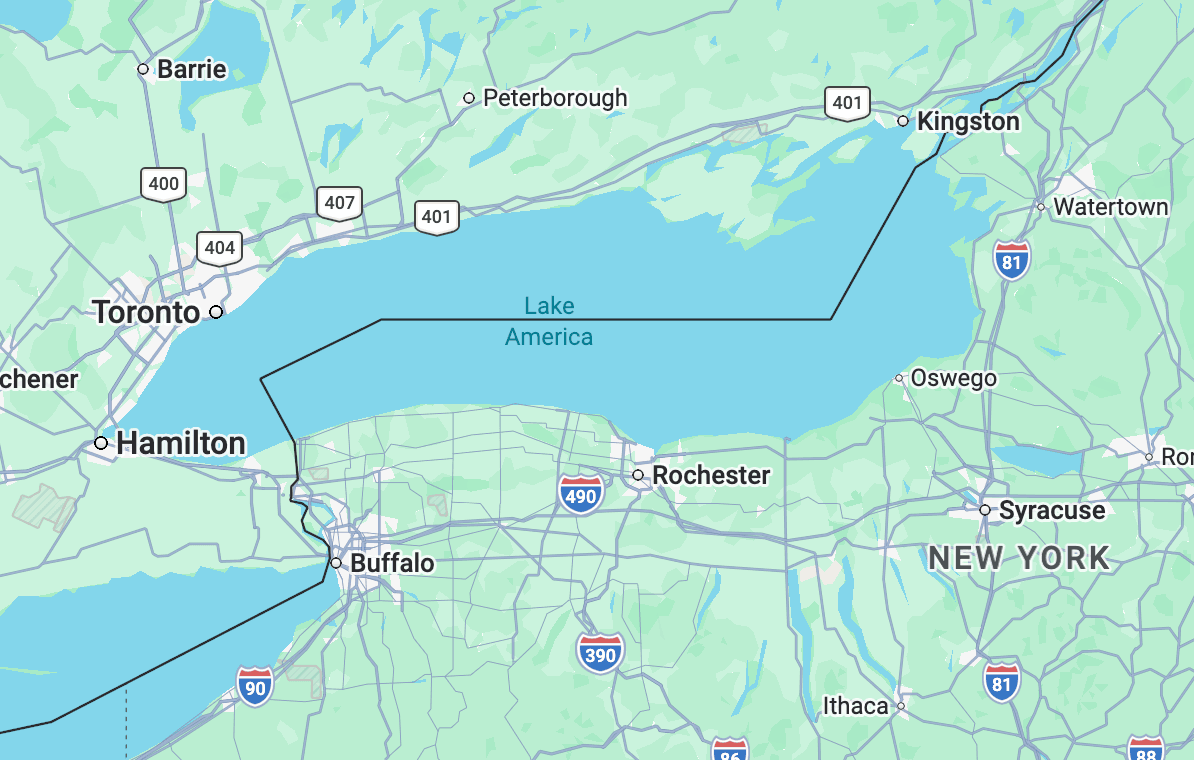
At 14:06 UTC on 30 August 2026, the prediction-market account Polymarket posted a one-line bulletin that, in the history of cartography, is a small event with an outsized diplomatic echo: "JUST IN: Google Maps officially relabels Lake Ontario as 'Lake America' for U.S. users." By 16:16 UTC, WIRED had the receipts, including the executive order that pushed the button. By 22:55 UTC, Google had confirmed the compromise: Canadian users will still see Lake Ontario, while the rest of the world sees "Lake Ontario (Lake America)." A single body of water on the US-Canada border has become the first major test of whether a private platform, under executive-branch pressure, can rewrite the map.
This is the cleanest case yet of three forces converging: a White House willing to weaponise nomenclature, a tech platform whose product is the de facto atlas of the internet, and a neighbour, Canada, with no formal veto over a label on its own shoreline. The framing matters less than the precedent. The next body of water, the next strait, the next disputed name sits downstream of this decision.
What Google actually did, and where
WIRED reported on 30 August that Google is "the first major online maps provider" to comply with the rename order, threading the political needle by region. Canadian users retain "Lake Ontario." US users see "Lake America." Users elsewhere see "Lake Ontario (Lake America)," a parenthetical that functions as a soft concession to both sides of the border. An X post by stats_feed captured the visual at 17:46 UTC on the same day, showing the US-side label flipped to Lake America while the Canadian side kept the original name. The visual artefact is the cleanest evidence in the public record that the regional carve-out is live, not announced.
The mechanism is familiar to anyone who watches platform governance. The provider with the dominant market share sets the default; everyone else, from delivery fleets to ride-share routing to weather services that ingest Google basemaps, inherits that default. A name change is a single edit in Google's product surface. The downstream consequences ride on whether other providers follow.
The order behind the label
WIRED ties the relabel directly to a Donald Trump executive order demanding the name change, without specifying the order number or signing date in the wire copy. Investing.com's 30 August bulletin corroborates the trigger, summarising the move as Google Maps showing "Lake America" in the US rather than "Lake Ontario." The remaining question, which the cited sources do not resolve, is whether the order applies only to federal maps and contractors or, by pressure and procurement, to private platforms serving US users. The Google implementation reads as the latter: a private company choosing compliance on its own map, not a federal cartographic agency acting in its own right. Polymarket's 22:55 UTC confirmation, relaying Google's own statement, makes the platform's discretion explicit.
Why Google, why now
Google sits at the choke point. Apple Maps, Mapbox, HERE, and OpenStreetMap each have material market share, but Google's basemap is the one embedded in third-party apps, vehicle infotainment systems, and emergency-services dashboards across the United States. A WIRED-grade product team can roll out a regional name change without rewriting tile servers; the marginal cost is, in platform terms, trivial. The cost of refusing is a confrontation with an executive branch that has, in other sectors, demonstrated a willingness to lean on platforms whose content choices displease it.
The pattern is older than this rename. Section 230 politics, content-moderation hearings, and the long-running antitrust cloud over Google's search and advertising businesses give the administration leverage that does not have to be exercised explicitly. A name on a map is the cheapest possible compliance, and the cheapest possible test of whether the leverage is real.
The Canadian problem, and the parenthetical workaround
Canada's response will define whether this stays a label or becomes a row. The cited wire reports do not name Ottawa or any Canadian government statement, and the available source items do not specify a Canadian response. The "Lake Ontario (Lake America)" compromise, however, is plainly built for a Canadian audience that includes millions of daily users who would otherwise see a foreign-imposed toponym on their own shoreline. Keeping Canada on the canonical name and the rest of the world on the dual label is the kind of granular regional carve-out that platforms now routinely build when political pressure and product reach collide.
The structural point is uncomfortable for everyone involved. A lake is a physical object. Its name is a diplomatic object. When a private platform, an executive order, and a foreign sovereign each have a claim to the toponym, the platform ends up writing the compromise, with no public process and no obvious appeal. Cartography historically belongs to national mapping agencies and to bodies like the United Nations Group of Experts on Geographical Names. The Google decision quietly substitutes a product team for both.
What this opens up
Two trajectories are now visible. The first is benign: the label holds, no other provider follows, the parenthetical absorbs the friction, and Lake Ontario remains a curiosity in a slow news week. The second is less benign. If the precedent holds, every contested toponym on the digital map becomes a pressure point. The Gulf of Mexico versus the Gulf of America debate, already live in US federal usage, sits one map update away. So do names in the Arctic, the South China Sea, and the Eastern Mediterranean, each of which has at least one government that would like a different label and one platform large enough to impose one.
There is also the question of leverage symmetry. The US executive branch can press a US-headquartered platform. It cannot press a Chinese or Russian provider to make the same change. If the global map fragments along jurisdictional lines, the practical effect is two, three, or four atlases where there used to be one. The "Lake Ontario (Lake America)" parenthetical is, read this way, the smallest possible version of a much larger fragmentation.
Stakes, in plain terms
For a Canadian reader, the immediate stakes are symbolic but not trivial. A lake that forms part of the border between two sovereign states is now labelled differently on each side of that border, on the most-used map in the country. For a US reader, the stakes are the inverse: a federal nomenclature preference has been transmitted, almost without friction, into the dominant consumer map product. For Google, the stakes are operational. Each rename order is a small compliance cost; each refusal is a small confrontation. The cumulative effect, over a hundred such orders, is a platform whose map surface becomes a quieter instrument of US federal naming policy.
The wider question is who writes the names on the map. For most of the twentieth century, the answer was the United States Board on Geographic Names and its equivalents abroad. For the twenty-first, the answer is increasingly a product team in Mountain View, working from a procurement-and-pressure gradient that no intergovernmental body controls. That is the precedent worth watching, more than the lake itself.
Monexus framed this as a platform-governance story, not a Canada-US dispute story. The wire coverage leaned on the executive order as the trigger; this article put the platform's implementation choice and the Canadian carve-out at the centre, because the precedent that matters is the mechanism, not the lake.
Wire provenance
This editorial synthesis draws on the following public wire/social posts:
- https://www.wired.com/story/google-maps-now-shows-lake-america-instead-of-lake-ontario/
- https://www.investing.com/news/stock-market-news/google-maps-will-show-lake-america-in-us-not-lake-ontario-4882054
- https://x.com/Polymarket/status/2094084806535454724
- https://x.com/Polymarket/status/2094197380199448617
- https://x.com/stats_feed/status/2094119577453994064
- http://nitter.perennialte.ch/Polymarket/status/2094084806535454724
- https://www.wired.com/story/google-maps-now-shows-lake-america-instead-of-lake-ontario/
- https://www.investing.com/news/stock-market-news/google-maps-will-show-lake-america-in-us-not-lake-ontario-4882054
- https://x.com/Polymarket/status/2094084806535454724
- https://x.com/Polymarket/status/2094197380199448617
- https://x.com/stats_feed/status/2094119577453994064
- http://nitter.perennialte.ch/Polymarket/status/2094084806535454724